When Living in the Past Is Your Only Sanctuary

I had coffee with a friend and former coworker recently, and we reminisced about some of the colorful characters we’ve worked with. One person we particularly admired has suffered through a life of depression, fear and anxiety and is mostly a recluse these days.

Mood music:

[spotify:track:6KfzBFMXEOs7LgBcG4ZxyT]

When this person does surface to talk to someone, the topic is always the old days. He carefully avoids the present because it’s so painful. Talking about the past is safer. We’ve been there. There are no strangers to deal with, no surprises. The past is etched in stone. It’s a safe cave you can hide in without worrying about the walls crashing in.

I understand why people with fear and anxiety hide in the past, because I used to do it all the time when my demons were getting the better of me.

I’ve always been a history buff, and I’ve read a ton of books on the subject, though lately I’ve been reading more music-related books. My interest is partly because I need lessons on how people in the past lived right and wrong. I want to read about the strengths someone used to make a mark on the ages and try incorporating some of that into my life.

But I’ll be honest: Those history books were a big, thick blanket I could hide under. Instead of trying to deal with the present, I’d loiter in FDR’s second-floor study in the White House (today’s Yellow Oval Room). I’d hang out in the smoke-filled rooms of Capitol Hill, enjoying a smoke of my own and watching the masters make grand bargains.

I did something similar by hiding in movies. By watching a Star Trek film, I could witness some adventure without getting shot or stabbed in the real world.

I think one of the reasons I don’t read quite as much history or watch as many science fiction films anymore is that I beat the fear and anxiety. I still have moments of anxiety, but not the fearful variety. With that fear gone, I’m more comfortable hanging out in the present and even participating in it. Good thing, too, because my work and family life leaves little time for the old ways.

True, reading a rock star biography deals with the past, too, but I also get a lot of information about how favorite songs I listen to today came about. Since I’m playing guitar again, I enjoy them even more.

I also go back to the history books on occasion. The difference is that I’m not afraid to leave the past when reading time is done. In fact, I’m usually eager to return to the present.

I’m praying hard that it’ll turn out that way for my old friend, because he deserves better.
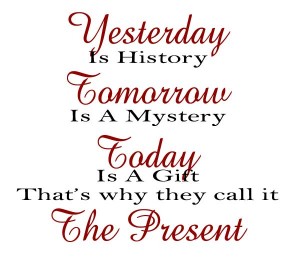
yesterday-is-history-tomorrow-is-a-mystery-today-is-a-gift-thats-why-they-cal-it-the-present

The OCD Diaries in Book Form

Erin and I are making plans for 2013. One is to turn The OCD Diaries into book form.

Mood music:

[spotify:track:0PexPf8SzDe0xu0OS3p7ya]

Almost since the beginning of this blog, readers have suggested that I do an OCD Diaries book. Flattering as that suggestion is, I sort of balked at the notion. This began as a memoir of sorts, and that might have been worth making a book out of. But the subject matter quickly evolved, and I’ve felt that wrapping the whole thing into one book would be cumbersome to the reader.

But Friday I got an idea: I could do a series of books &mdash smaller, bite-sized works we could make available in print and digital formats. I could set them up to have the feel and reading experience of the Devotionals you see offered in various religious communities. The print editions would be pocket-sized so you could pull ’em out as needed.

So far, we’re planning topics to include:

  • Dealing with OCD, depression and other disorders
  • Living through addiction
  • Dealing with grief
  • Spirituality
  • A survival guide for children and parents
  • A survival guide for relationships
  • Life with Crohn’s Disease and how the related coping tools apply to a multitude of health challenges
  • A book of humor, featuring selections from humor writers I admire
  • The common element tying it all together will be pieces of my back story, what I’ve experienced and how I’ve learned to manage the challenges.

    These will not be books telling you how you should live. I’m the last guy on Earth who should be advising you on that. They will simply be stories of what I’ve done and why, with lots of resource material so you can seek out the professional experts.

    Onward.

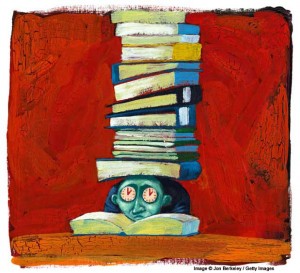
    Pile of Books

Me, Duncan and December-itis

I’ve had a lot to say lately about my own efforts to manage winter’s depressive effect on my brain, but this is also a challenging month for my younger son, Duncan.

Mood music:

[spotify:track:7BeOWHtwV9IQ7jmqwwvvLP]

I’ve written at length about Duncan and my struggle to help him when his ADHD comes crashing into my OCD. I’m proud of who he’s becoming. But no matter how much progress father and son make on our mental health, December may well remain the month that throws us for a loop.

I feel like I’m having an easier time of it this year. I have depression, but it’s just the tired, memory-challenged kind. So far I’ve mostly escaped the feelings of sadness and outward crankiness of past years. Yesterday I visited the nurse who manages my medication and she doubled my Wellbutrin intake for the winter.

Now it appears to be Duncan’s turn for such an adjustment. His teacher has been praising his behavior all fall but, like clockwork, he started experiencing difficulty in class as the calendar switched to December. We’re hearing about the usual winter outbursts. He’ll argue with classmates, his temper comes to a boil easily and so on.

It kills me every year when this happens, because I know he inherited his mental health challenges from me and my side of the family. It’s not his fault.

The good news is that we’re getting better at anticipating his behavioral changes and responding faster. This afternoon I’m taking him to an appointment where his medication might be adjusted. We’ve also been blessed with some outstanding, nurturing teachers. I was particularly fond of his first-grade teacher, who was there when Duncan first got his ADHD diagnosis. She worked closely with us to make adjustments in the classroom that helped immensely.

His teacher this year is another gem. She meets with us whenever we ask and keeps us informed of Duncan’s progress by email. When he started acting up a couple of weeks ago, she invited us to call her at home in the evening. Few teachers do that these days, and we’re grateful for it. Duncan also has terrific classmates who cheerfully help him stay organized. And when he has a mood swing, they’re patient with him. Impressive, when you consider they are all under the age 10.

I chalk it up to the loving environment of the school. The place is far from perfect, as I’ve noted before. But as time goes on, I’m more convinced he’s exactly where he should be.

The trick now is to get him — and his teacher and classmates — to the other side of winter in one piece.

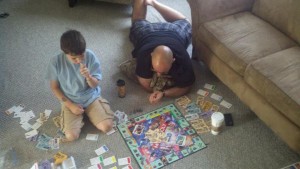
Duncan and Bill

‘Lincoln’ Captures Presidential Triumph Over Depression

Since Steven Spielberg’s Lincoln arrived in theaters, I’ve been asking myself: Is the depression issue adequately addressed?

The 16th president is a hero of mine because he showed depression sufferers how to rise above the despair and even turn it into a powerful ally. In fact, it was the subject of one of my first posts when I started this blog.

Mood music:

[spotify:track:0WKNW7g0aTpenB8jdsxlfD]

Lincoln lived through horrific episodes of melancholy in an age where there were no meds to help take the edge off. Rather than succumbing to the scourge and taking his own life, though he did consider it more than once, according to Lincoln’s Melancholy by Joshua Wolf Shenk, he developed layers of coping tools that carried him through terrible periods of grief, which included the loss of two children (Willie Lincoln died in the White House barely a year into his father’s presidency) and the darkest days of the Civil War.

When I first saw previews for Lincoln, it was clear that the film would focus on the fight for the 13th Amendment to the U.S. Constitution, which finally outlawed slavery. But it was unclear how much we’d see Lincoln dealing with the melancholy.

I’m happy to report that it tackled that part of Lincoln’s greatness to my satisfaction.

We see Lincoln’s difficult relationship with his wife, Mary Todd Lincoln. We see him putting his personal grief aside to comfort his youngest son, Tad, who still struggles with the loss of his brother. We see him standing firm in the face of heated opposition over the 13th Amendment, which many in his own circle consider a daft distraction from the business of ending the Civil War.

His coping mechanisms are on full display, especially his sense of humor and writing. We see him telling off-color stories during moments of high tension. We see him using the power of writing to rally himself and his countrymen through the obstacles ahead.

Daniel Day-Lewis really does an inspiring job capturing those strengths.

The movie isn’t perfect. Like most books and films dealing with Lincoln, the president is portrayed in an almost Christ-like manner, glossing over flaws the man certainly had.

The film shows Lincoln pushing to end slavery as a simple matter of morality when a deeper read of history shows that, at the beginning of the Civil War, he was perfectly willing to allow slavery to survive in the South under certain conditions. Keeping the Union together was his primary goal from the outset, not abolishing an evil institution. His parenting also left much to be desired, when you consider how he kept a certain distance from oldest son Robert and coddled Tad almost to the point of spoiling the boy. Meanwhile, certain civil liberties took a beating under Lincoln. He suspended the writ of habeas corpus, paving the way for unlawful detentions, as one of my libertarian friends often points out.

But I can forgive Spielberg. Lincoln was an imperfect person, as we all are, but his evolution as a human being was profound and inspiring — especially his growth in tackling depression. The movie captures it well.

Go see it.

Lincoln Movie Poster

THE OCD DIARIES, Three Years Later

Three years ago today, in a moment of Christmas-induced depression, I started this blog. I meant for it to be a place where I could go and spill out the insanity in my head so I could carry on with life. In short order, it snowballed into much more than that.

Mood music:

[spotify:track:2o3ZNeSBuMEt7e3zZbTLk9]

About a year into my recovery from serious mental illness and addiction — the most uncool, unglamorous addiction at that — I started thinking about sharing where I’ve been. My reasoning was simple: I’d listened to a lot of people toss around the OCD acronym to describe everything from being a type A personality to just being stressed. I also saw a lot of people who were traveling the road I’d been down and were hiding their true nature from the world for fear of a backlash from it.

At some point, that bullshit became unacceptable to me.

I got sick of hiding. I decided that the only way to beat my demons was to push them out into the light, so everyone could see how ugly they were and how badly they smelled. That would make them weaker and me stronger. So I started this blog as a stigma-busting exercise.

Then a lot of you started writing to me about your own struggles and asking questions about how I deal with specific challenges life hurls at me. The readership has steadily increased.

Truth be told, life with THE OCD DIARIES isn’t always pleasant. There are many mornings when I’d rather be doing other things, but the blog calls to me. A new thought pops into my head and has to come out. I’ve lost friends over things I’ve written. When you write all your feelings down without a filter, you’re inevitably going to make someone angry. But I’ve made many, many friends through this endeavor as well.

Earlier this year, I seriously considered killing the blog because of the strain it had put on some relationships. A lot of you told me to keep it going and I have. But Erin signed on to help, and together we made big changes.

We redesigned the blog and moved it from WordPress.com to its own domain. I expanded the subject matter beyond OCD and addiction to include commentary on current events as they relate to our mental state.

We built a Facebook page and broadened the discussion there. If you haven’t been there yet, please go and like it.

We started using Spotify and Soundcloud for the mood music I put atop most posts. We had our kick-ass designer, Andy Robinson, change up the banner to reflect the broadening subject matter. And we’ve built a resources section that continues to expand.

The biggest change for the blog this past year — making it into a partnership with my wife — has meant the world to me. I love that this is something we do together.

We’re starting to plan for 2013, and I’m pretty stoked about what’s on tap.

Thanks for reading.

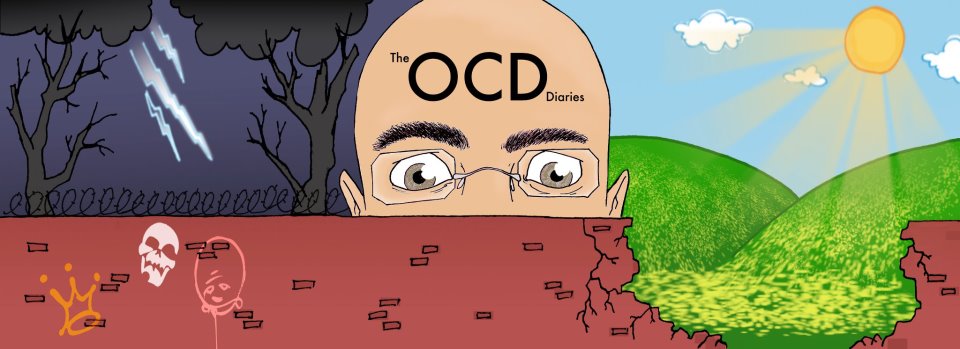
OCD Banner

Traffic Jam Meditiation

When I was younger and more anxious, traffic jams used to push me to the point of madness. I’d let the f-bombs fly. I’d flip people off (I did that once with my future in-laws in the back seat). I’d punch the roof of the car so hard and so often I’d leave dents and tear the fabric.

Mood music:

[spotify:track:5Uw5Hdjb2zAZPR6YJKWlGK]

Flashback, 1989: 

It’s registration day at North Shore Community College, where I’m enrolled for the fall semester. I’m just out of high school and angry at the world for a variety of reasons. I’ve been working long hours in my father’s warehouse in Saugus, and I’m rubbed raw. I’m frustrated because a girl I like is getting cold feet about the idea of hooking up with a loose cannon like me. It doesn’t take much to trigger a temper tantrum.

That day I was rattled hard by the long lines of college registration. I wasn’t expecting it and was full of fear that I wouldn’t get the classes I needed. Not that it really mattered, since my major was liberal arts.

Two hours in, I realized I had to give them a check for the courses I was taking. I had no money and panicked. They allowed me to drive to Saugus to get a check from my father. I was in full road rage mode on the drive there and back, crawling up the bumpers in front of me, riding the horn and yelling out the window with tears running down my face. Clearly, the world was coming to an end at that moment.

By day’s end, I was breathing into a bag between the chain of cigarettes I was smoking.

I still get claustrophobic and somewhat anxious in traffic jams. Yesterday was a prime example. I-93 north was a parking lot and it took nearly two hours to get home. I was already tired and under the spell of winter-induced depression.

But I got through it without a tantrum. I’ve developed a nice meditation for moments like these.

I’ve been drinking tea on the ride home, turning the typically hour-long commute into a break time of sorts. I crank up the music and get comfortable. I do a little praying. In yesterday’s case, I prayed for the safety of anyone who might have gotten hurt in an accident up ahead. I did some breathing exercises I learned in a recent mindfulness class.

I was still pissed and cranky when I got home, especially since I had to get right back in the car a short time later to take one of my sons to his Cub Scouts meeting. But I wasn’t a freaked-out madman.

That’s progress I can be grateful for.

I’m also grateful for Erin. I always am, but yesterday, knowing I was thrown behind the eight ball, she did some of my chores for me. That took a load off my shoulders.

Thanks, honey.

Road Rage

How Christianity Hijacked Pagan Holidays

Christian extremists like to blather on about a war on Christmas. Given that my post “Take Your ‘War On Christmas’ Talk And Shove It” has been getting a lot of traction on Facebook this week, I think it’s time for a history lesson.

Mood music:

[spotify:track:0P2vAvvWni2tNXOdbH3JFk]

We hear a lot about how Christmas is a Christian holiday, which it is, but important facts are being forgotten. One is that Jesus wasn’t actually born on Dec. 25. Another is that many of our Christmas traditions—the lights, decorations and gatherings—originated with pagan cultures.

One reader, John Conner, commented to that effect yesterday. He said:

This whole controversy is bogus to begin with. Any biblical scholar worth his or her salt will tell you that Jesus WAS NOT born on Dec. 25. That is the date of the pagan feast of Yule, closely following the winter solstice a few days prior. Many, many traditions celebrate Dec. 25 as a holy day, not just Christians.

On the Christian History website, Elesha Coffman wrote that for Christianity’s first three centuries Christmas wasn’t even celebrated. She wrote:

If observed at all, the celebration of Christ’s birth was usually lumped in with Epiphany (January 6), one of the church’s earliest established feasts. Some church leaders even opposed the idea of a birth celebration. Origen (c.185-c.254) preached that it would be wrong to honor Christ in the same way Pharaoh and Herod were honored. Birthdays were for pagan gods.

The Yule holiday is rooted in German paganism. Modern-day Wiccans still celebrate the winter solstice as a time of rebirth.

Coffman wrote that Dec. 25 also marked two other festivals: natalis solis invicti, the Roman “birth of the unconquered sun”, and the birthday of Mithras, the Iranian “Sun of Righteousness.” Since pagans were already celebrating deities with some parallels to the true God, Coffman wrote, church leaders decided to commandeer the date and introduce a new festival.

Remolding pagan traditions into a Christian holiday was pretty clever. You might even say it was devious. Either way, it turned out for the good. December is now a time where a melting pot of faiths and cultures celebrate the best of humanity: our charitable instincts, a trust in a higher power and the desire to see good win out over evil.

I choose to celebrate as a Catholic grateful that Christ was brought into this world, giving us all a shot at redemption. But I refuse to embrace the notion among today’s Christian leaders that Christmas has been hijacked by a collection of pagans who deny Christ’s divinity.

It was the other way around, many centuries ago.

My more-extreme Christian brothers and sisters need to get over it.

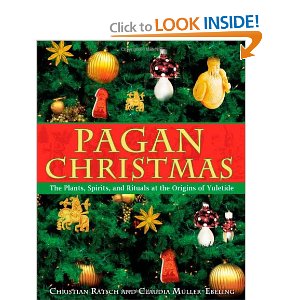
Pagan Christmas

Pagan Christmas: The Plants, Spirits, andRituals at the Origins of Yuletide

Five Inexpensive Christmas Gifts for the Depressed

It’s easy to find Christmas gifts that poke fun at a person’s OCD. I’ve captured some good ones and bad ones in previous posts. Less easy to find are gifts that are appropriate for a person in the grips of depression.

Why are these gifts so hard to find? One reason is that if you are suffering from depression, especially from the sad, suicidal variety, gag gifts can backfire, adding to the hurt because the recipient feels they are being mocked. All gag gifts mock, mind you, but it’s easier to see the humor when the world doesn’t look like it’s about to implode.

Another reason is that we can’t always tell a person is depressed. Sufferers can be masters at masking their feelings. It’s hard to get a gift to help a person if you don’t know they need help in the first place.

But the biggest reason is that the gifts a depressed person needs usually can’t be found in the mall or on Amazon. Sure, getting stuff can make you feel good for a short while. That’s why people run up their credit cards for retail therapy. But the good feelings won’t last long if there’s a gaping hole in your soul.

With all that in mind, I’m going to take a crack at gift suggestions that might really help the depressed soul. Despite what I said about material things, those included here can a positive, almost medicinal effect. These items are based on my personal experiences. It is not meant to be the definitive word on the subject, nor is it meant to be a one-size-fits-all list.

  • A HappyLight. If the root of a person’s depression is the darkness of winter, getting them a natural-spectrum light can give them a dose of springtime. The lamp blasts a room full of the kind of light you would normally get from the sun. In 30-minute intervals, the lamp has provided me with a boost.
  • Music. For any type of depression, few therapies are as powerful as music. In my case, massive doses of hard rock gives me immense strength and comfort. The key is to be sure of what the recipient likes, be it country, classical, jazz, etc. You can deliver this gift in multiple, inexpensive ways. One is to get some blank CDs and burn some songs on to them. If you know a person’s tastes, chances are better than average that you share those tastes and have music in your collection that can be passed on.
  • Homemade treats. Find out the recipient’s favorite foods and, if you have the cooking skills, make it. Homemade will always make a more personal statement than buying something from a grocery store. My wife gets that, and if someone is having a birthday, she insists on making the cake herself. Buying from a bakery is unthinkable to her except for certain situations. But be aware that a gift like this could backfire. In my case, depression has compelled me to binge eat in the past. You don’t want to enable a person’s addictive impulses. Make sure food isn’t the problem for your recipient.
  • Your time and attention. When a person is badly depressed, the biggest source of pain is isolation and loneliness. Visit this person often, call them and, if they’re on Facebook, check in with them daily. Don’t lecture them on how blessed they really are or what kinds of vitamins they should be taking. One of my personal peeves is when someone tries to tell me about self-help books I should read. Trust me: When you’re depressed, the only reading you crave is material to help you escape. Just show up and talk about whatever. Or, better yet, just sit there and listen to them. Let them vent without trying to make judgments.
  • Space. Sometimes, a depressed person just needs space. Their depression can be made worse when people bug them with suggestions on what they should do about their problems. Just as human contact can be a powerful gift, so can solitude.

The trick with give someone who is depressed a worthwhile gift is knowing what they really need. While asking them directly may be out of the question — they’re not likely to know or be willing to ask for it — pay attention to them and you’ll find inspiration.

Charlie Brown Christmas

Another Christmas Season, Another Depression Diagnosis

Though I’ve made peace with the demons that left me hating Christmas for many years, I’m still easy prey for winter depression. Last week, after asking me lots of questions and taking lots of notes, my shrink told me what I already knew: I’m once again clinically depressed.

Mood music:

[spotify:track:0feXvJJWws7RDvC0kHfbLr]

When most people hear the word depression, they immediately think of someone who is sad, anguished and afraid to leave the house. In the more extreme cases, death becomes an appealing option for ending the pain. I’ve never been suicidal, but I have experienced the other things in my day.

This depression isn’t like that at all, however.

I’m not sad. I’m not anguished. I’m not even in a bad mood (as I write this, anyway). I feel incredibly blessed every day. I’m in love with my wife, kids and extended family. I immensely enjoyed decorating the Christmas tree yesterday. I recently described this state of mind as happy depression.

In my case, being clinically depressed means three things:

  • I’m tired a lot.
  • I’m forgetful to the point where my wife wants to club me at least once a day.
  • I’m experiencing fluctuations in appetite. That used to result in days and weeks of binge eating. This time it’s a lack of appetite. Frequently at meal time, I’m simply not interested.

For some species, seasonal depression isn’t even considered depression. If you’re a bear, for example, it’s simply time to hibernate for the winter. I guess that makes me part bear, because that’s essentially how I am these days. My body says it’s time to hibernate. But humans don’t get to curl up in a warm cave until spring.

I still have parenting to do, a job to do, family to attend to. And so I do. I just do it in a messy, disorganized fashion this time of year.

To some extent, this is something I have to accept. My family has to accept it to. It’s a medical condition, and you can’t just flip a switch and turn the light back on. I can, however, minimize it. I’m going to get my meds adjusted now instead of halfway through winter. I’m also going to build a routine to use all the new present-awareness tools I acquired during my recent mindfulness-based stress-reduction class.

I meditated this morning for the first time in a couple weeks, and it did make a difference. At the least I started the work day in a calm enough mental state to plow ahead with work.

I’ll keep you posted on my progress.

Christmas Lights