A friend of mine was taken aback yesterday when I used a text she sent me in a post. I thought it would be OK because I was keeping her identity a secret. But in hindsight, I should have asked first.
That’s the challenge with a blog like this. I need to take things right to the danger line to make points I feel need making. But sometimes I step over that line. I’ve worked on being extra careful, but it’s obviously a work in progress.
But there’s a bigger point to this than my own foolishness. My friend was not amused by what I did and she made it known. But she quickly forgave me and on with life we go.
That’s one of the many things I admire about this friend. She’ll get angry and sound off, but she doesn’t hold a grudge and freeze out the folks who get on her bad side.
As many of us know, holding grudges is the easiest thing in the world to do. So is NOT holding grudges.
That’s a sign of deep character and strength. I’m lucky to have her as a friend, despite myself.
I’ve made a lot of wonderful friends among the parents in my children’s school community. But like every community, there are people who blow things out of proportion.
Mood music:
I guess you could lump me into that class of parent. I needle people, especially when I like them, and I can be like a bull in a china shop at school events. I’ve also engaged in gossip with some of the parents.
It’s easy to forget your own faults when your kid suddenly becomes the subject of that schoolyard gossip. But that’s what happened Friday afternoon.
I was sitting in my living room doing some work when I got a text from a friend whose daughter is in Duncan’s class:
“Just wanted to give you a heads up that a lot of moms are pissed at school … I guess Duncan was telling (his classmates) that Santa doesn’t exist and that the parents (do the work). Some of the moms are sending texts to everyone! I have gotten six so far!”
Duncan told us about a month ago that he figured out that Santa, the tooth fairy and the Easter Bunny don’t really exist. Ironically, he reached this conclusion because, as he told me, “To do what they do they would have to use magic. And magic isn’t real.”
That’s his point of view, of course, and truth be told we were sad about the whole Santa thing. No one wants their child to shed innocence before the age of 10, right?
We asked Duncan not to discuss it at school because a lot of his classmates still believed, and that they should be allowed to believe. We apparently needed to give him more than one reminder.
As I learned that several moms were texting each other wildly that Friday afternoon, warning parents that Duncan Brenner told kids at school Santa is a fraud, my blood ran cold and my head got hot.
How dare these moms trash talk my son, I thought. There they are, texting each other like some big emergency is afoot, in this case the potential destruction of Christmas.
The suggestion in this kind of parental banter is that the kid who can’t keep his mouth shut is a troublemaker. His parents must be troublemakers, too.
My first instinct was to get the names of the parents and apologize on Duncan’s behalf. Then my mood shifted and I wanted to tell them all off. Now, with my attitude somewhere near the center again, I’m writing this out, looking for the right perspective.
A few things occur to me:
–Kids in the school yard are going to talk about all kinds of things we’d rather they not talk about. There will be profanity and bad jokes. We parents should intervene whenever possible, but we’re not always going to be in the right spot at the right time.
–If someone is worried that their kid’s Christmas will be ruined over this, do you think it might be time to re-examine what Christmas is supposed to be about?
Here’s what really bothers me:
We all have a habit of gossiping. It’s a very human thing to do. But you know what? It’s wrong.
Schoolyard gossip rarely accounts for the things that are really going on with the kids and parents at the center of all the chatter. We make harsh judgments without having all the facts.
A good example is the mom who started trash-talking about a pair of siblings, suggesting they had anger issues over their parents’ impending divorce because the older sibling refused to work with her son on a class project.
Missing from that bit of gossip was the fact that the girl didn’t want to work with him because he was slacking. Also, he’s been teasing and tormenting her since Pre-K and she finally decided to take a stand.
This is a community and, like it or not, we are all responsible for making it work. Many parents already work tirelessly to that effect, but some do too much complaining about others who don’t march in lockstep.
That’s mean. It doesn’t inspire other parents to get involved and help. It’s not OK. We all have flaws and so do our kids. It also never accurately captures the reasons some people do what they do. We have no idea if someone is acting out of depression, heartache, work stress or any number of other things.
We can’t shield our kids from all the unpleasantness of life. Nor should we. When we coddle our kids too much, we do them a disservice by not preparing them for the challenges of life.
We should let them deal with some of the unpleasant topics of a schoolyard during recess because they just might learn something valuable in the process.
We should remember that when one kid says something other kids aren’t ready to hear that it’s not the end of the world. It’s may lead to unpleasant dinner conversation at home that evening, but it hardly qualifies as a crisis.
Above all, we should all remember that gossiping is mean, and kindly knock it off.
I recently watched Diane Sawyer’s interview with Congresswoman Gabby Giffords and her husband Mark Kelly. To say I was moved would be an understatement. Hers is the story of a spirited fight back from near death.
If you ever get the feeling you can’t do something or overcome big challenges, you should watch this. It will show you that nothing is too big to overcome.
She said that she would never have sent such a bad report card to her adult child. I think she was also upset at the suggestion that my parents weren’t paying adequate attention to me back then.
I don’t mind, though. In fact, I’m happy to have that old report card. It put things in perspective for me. It was a snapshot of a difficult time. I used to get angry when thinking about those days. I had a lot of hate in my soul over it.
I don’t feel that way anymore. I think everyone did the best they could with the tools they had back then. The problem was that the tools weren’t that great.
But everything turned out fine.
Below is the original post. Have a look and tell me if you would be upset if such a report card were sent to you.
And to my friend: I appreciate your reaction to the original post very much. Yours is a friendship I treasure, and I don’t want you to worry about this one. Hence the sequel post.
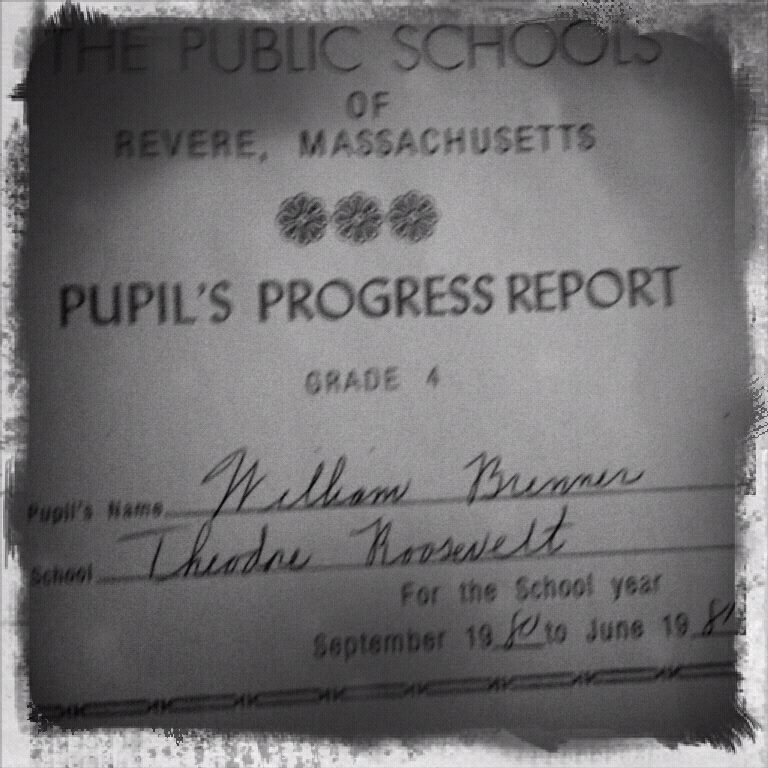
My mother found my fourth-grade report card the other day and mailed it to me. On the surface it shows a chronic C student who doesn’t give a damn about anything.
But when I read between the lines I can see exactly where my 10-year-old head was at.
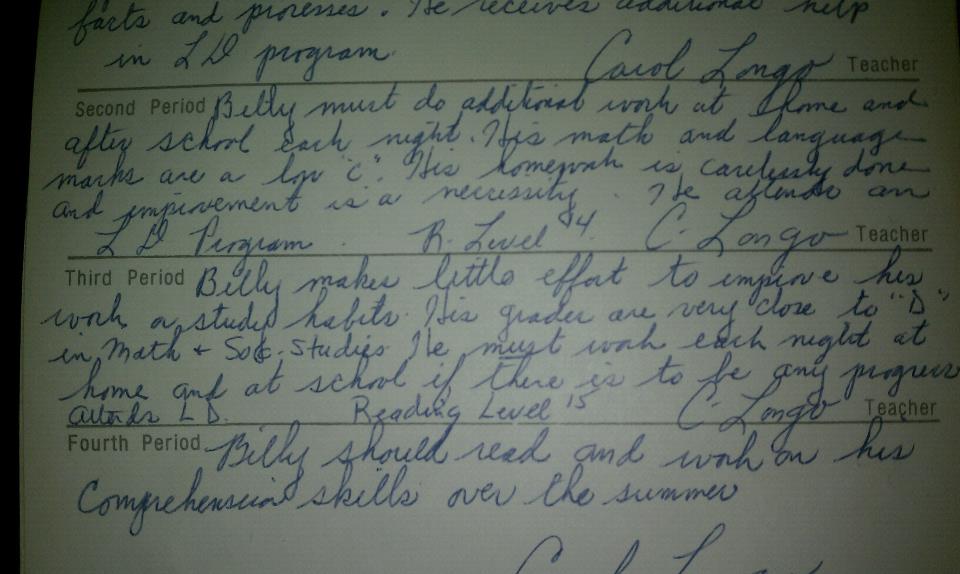
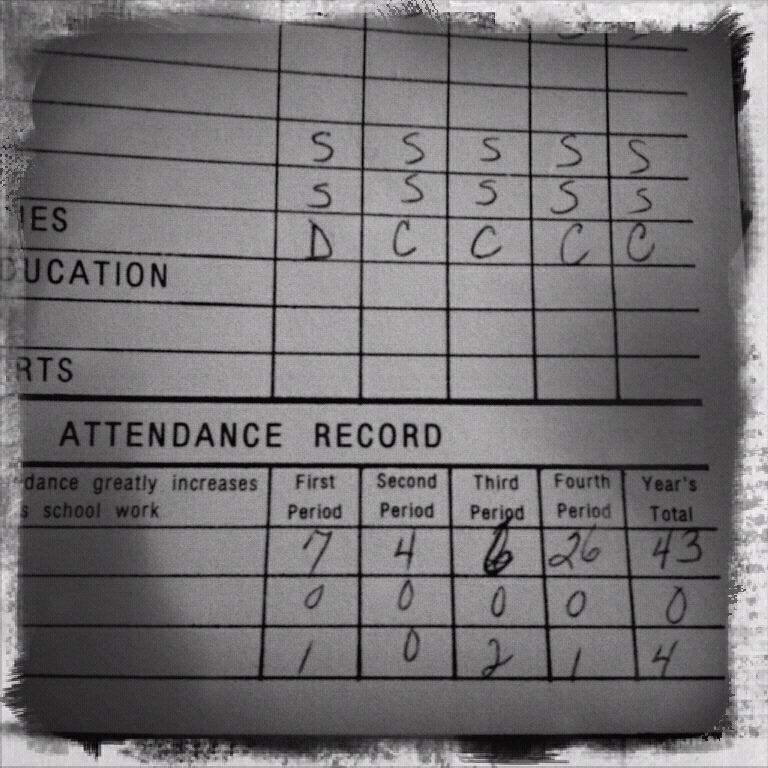
If you look at it on the surface, you see a straight-C student who occasionally sinks to a D in social studies and math. On the back of the report card are comments each quarter from my teacher, describing me as a kid who puts no effort into anything.
My first thought on reading it was that this teacher didn’t like me, and that the feeling was mutual. In reality, I don’t think she disliked me. I think she saw a kid adrift and was trying to scare my parents into a more rigorous study routine at home.
Unfortunately for her and me, she wasn’t the type of teacher who was going to get through to me. She took the academics very seriously, but did little to appeal to the more creative side of me. Teachers before and after her would have a lot more success in that regard. She didn’t get me and I didn’t get her. A troubled kid needs nurturing personalities to intervene.
Even as an adult who has enjoyed a fair amount of career success it’s the same:The more nurturing bosses get more out of me. The ones who shove a 13-point plan in my face and tell me to do it get nothing but trouble. Luckily for me, I’ve only had a couple bosses like that along the way.
I have been both types of boss myself, and I’ve found that most people do better with supervisors who are nurturing souls.
My parents divorced in the summer of 1980 and it was not a civilized, amicable process. The yelling and instability sent me on to such soothing pursuits as lighting things on fire and shoving the garden hose into an air vent on the side of the house.
I was also sick most of the time with Crohn’s Disease. If you look at my attendance record, there’s a 20-plus day absence in the fourth quarter. That was for one of my extended hospital stays. I missed the class picture shoot that spring, which is probably for the best. I wasn’t a pleasant site.
Erin was pained to look at my report card. She never got grades so consistently bad. She felt sympathy for the teacher, who was obviously trying to get my parents’ attention. But in the raw wake of divorce and the illnesses me and my older brother suffered from, they obviously were distracted. I don’t blame them.
I suppose I should have felt sad looking at the report card, but I don’t. I see it for what it was — a snapshot of a difficult period of time. I survived it, and turned into an excellent student once I had a couple years of college under my belt. I would argue that despite it all, I turned out just fine.
What makes me even happier is that at least to date, my children do well academically. Duncan has some ADHD-related challenges, but his grades are mostly good and he has a heart I didn’t have at that age. That heart will take him far.
Sean is currently the same age I was when I brought home that report card. He’s razor-sharp academically, though like me at that age, he often rushes through his homework, the most notable evidence being his sloppy penmanship. We can work with that.
I’d like to think that their better academic luck reflects that we’re giving them a good home life — better than mine was, at least.
To me, the big lesson is that when a kid brings home a bad report card, it’s not enough to just look at the grades and brand the student a success or failure based on the letters and numbers alone.
There’s always a story behind the grades, and taking the time to know the story is key to helping that child going forward.
I don’t like using this blog to make political stands. But one look at the legislative swill known as the PROTECT IP Act in the Senate and Stop Online Piracy Act (SOPA) in the House and I knew I had to speak up.
Mashable posted an infographic that describes the threat much better than I ever could with words. Allow me to share:
The Electronic Frontier Foundation (EFF) does a good job of explaining what’s at stake on its website:
The Internet Blacklist Legislation – known as PROTECT IP Act in the Senate and Stop Online Piracy Act (SOPA) in the House – is a threatening sequel to last year’s COICA Internet censorship bill. Like its predecessor, this legislation invites Internet security risks, threatens online speech, and hampers Internet innovation. Urge your members of Congress to reject this Internet blacklist campaign in both its forms!
Big media and its allies in Congress are billing the Internet Blacklist Legislation as a new way to prevent online infringement. But innovation and free speech advocates know that this initiative is nothing more than a dangerous wish list that will compromise Internet security while doing little or nothing to encourage creative expression.
As drafted, the legislation would grant the government and private parties unprecedented power to interfere with the Internet’s domain name system (DNS). The government would be able to force ISPs and search engines to redirect or dump users’ attempts to reach certain websites’ URLs. In response, third parties will woo average users to alternative servers that offer access to the entire Internet (not just the newly censored U.S. version), which will create new computer security vulnerabilities as the reliability and universality of the DNS evaporates.
It gets worse: Under SOPA’s provisions, service providers (including hosting services) would be under new pressure to monitor and police their users’ activities. While PROTECT-IP targeted sites “dedicated to infringing activities,” SOPA targets websites that simply don’t do enough to track and police infringement (and it is not at all clear what would be enough). And it creates new powers to shut down folks who provide tools to help users get access to the Internet the rest of the world sees (not just the “U.S. authorized version”).
Here’s why I see this legislation as a security threat:
Even though it’s not the bill’s intent, the language would give the government power to squash any website it deems in violation of the law. If a big technology company were to object to content posted on a security research site or blog — details of a software vulnerability, for example — it could lean on the government to block it. The big vendors would then be free to sit on vulnerabilities for as long as they wanted.
But that’s just a small piece of the problem.
When you think of all America’s efforts to protect its citizens, the goal is always to protect A WAY OF LIFE. Our right to free speech and expression. The Internet has allowed that freedom to flourish in the form of personal blogs, social networking and so on. If the government gets the power to block that freedom, all our other security efforts will be rendered meaningless.
That’s my security argument. But let’s look at this in the scope of personal blogging. I started this blog to break stigmas around mental illness and addiction. There are many other blogs out there with similar missions.
This legislation threatens all of it.
A few months ago I wrote a post about how I was ripped off by The Midwest Center For Stress and Anxiety and how, in my experience, it’s a sham. That post has gotten more page views than any other I’ve written, and it has received countless comments, most of them mirroring my own experiences.
If this law were enacted, The Midwest Center could petition the government to block my site for posting content harmful to it’s business interests.
The government would also have greater authority to block much of the content we all post on Facebook.
I don’t deny that there is a problem with pirated content in this country. But this kind of response is typical of the entertainment industry.
Instead of embracing the new ways people choose to get their multimedia content, the industry tries to punish us instead. Their profits are drying up because consumers are abandoning them.
When your business can’t adapt to changing times, it doesn’t survive. It’s simple. It’s fair. The entertainment industry and big software companies can’t handle this simple truth. So they’re using the government to beat consumers into submission.
There’s a guy I used to work with who was always a pleasure to be around. I loved his humor and work ethic, and, thanks to Facebook, I get to stay in touch with him. But I’m worried by what I see right now.
Mood music:
[spotify:track:7Foti4A082iVkY8Az1hvlX]
By now this guy has probably figured out that this will be about him. He need not worry. I’m not going to name him or the place where we worked together.
He’s gone through a rough patch in recent weeks and his depression is bleeding all over his Facebook page. That happens with most of us. But he keeps talking about losing himself in his food. I’ve been down that road, and need to do what I can to knock sense into him.
From this point on, I’ll be speaking directly to him:
My friend, you don’t want to hear any of this, but you need to. You’re slowly killing yourself because life has hit a rough spot. You’ve been through rough periods before and got past them. This will be no different.
People have this stupid notion that you can’t call yourself an addict unless you drink too much or take drugs. But addiction covers anything we think we can’t live without. That includes relationships.
People like us walk around with a hole in our soul. We think we can fill it with things that give us a few moments of pleasure and solace. But it never works. The hole gets bigger, because the stuff we’re addicted to is really a corrosive agent, eating through the core of who we are.
Everyone struggles with something.
Everyone struggles with relationships. Everyone looks for comfort in certain behaviors: Eating, drinking, smoking, sex, spending, Web surfing, music, exercise, mountain climbing, gum-chewing, TV.
Just about everyone struggles with the difference between having enough of the items I just listed and not knowing when it’s enough. People eat too much all the time and casually make note of it. People get drunk and the headache they wake up with the next morning tells them they went too far.
There’s a tight parallel when it comes to mental illness, the main focus of this blog. Everyone struggles with times of depression, anxiety, mental fatigue, personality conflicts. Those very things are what usually drives a person to addictive behavior.
It’s all part of being human. That’s why the readership of this blog keeps growing. Everyone struggles and relates to the cause and effect.
But when does addictive behavior become the stuff of evil — a cancer that takes you over body and soul until satisfying the itch becomes the priority over all else?
That’s where we try to separate the so-called normal people from the crazies. I say try because one person’s crazy is another person’s normal.
We all think we know the difference between normal and crazy. But most of the time, we don’t know shit.
I can only tell you where my sense of normal crossed over into insanity. I’ve told you in a million different ways in this blog already.
To me, the key to recovery is partly about identifying when a behavior makes life unmanageable. Not the typical idea of unmanageable, where a person might always be scattered, nervous, hyper or lazy, thus becoming difficult to be around.
No, I’m talking unmanageable in the sense that your life is like a car speeding out of control, where one tire is flat, the engine has run out of oil and the back bumper is hanging off and causing sparks as it drags on the ground. The vehicle is ready to fall apart, and yet it keeps going faster and faster.
The addictive behavior that does that to your life is the insidious devil whose head must be ripped off if you’re going to make it.
For me, clinical OCD has always been a driver of my addictive behavior. I had to bring the OCD to heel before I could even begin to deal with the addictions. The 12 Steps of Recovery are key to my ability to manage both.
I’m not saying the 12 Steps is what you need. It works for me, but there’s more than one way to skin this beast.
I’ve broken my addictive behavior into categories that have more to do with what makes me insane than what is simply considered good or bad for you.
I love cigar smoke. Smoking is bad for you.
I love coffee. Some say that’s bad for you, though I don’t really believe it.
I love spending money on things. Who doesn’t? But spending too much can ruin you and those you love.
I love music. Some days I’d rather sit around listening to rock and roll than doing any number of other things I should be doing.
All of that can be considered addictive behavior. But binge eating, followed closely by alcohol and third by the prescription pills I used to take for back pain — those are the things I craved so badly that at one point I was willing to let everything else in life go to hell.
Fifteen years ago I lost the friend who had become my older brother and rudder. A vicious cycle of depression destroyed his body, but it failed to kill his soul.
Mood music:
For a lot of my more religious friends, that has to sound odd, if not foul. We’ve been taught that suicide is a mortal sin, the kind that sends the soul straight to hell. I used to believe that. Now I think that line of thinking is wrong, stupid and even a little dangerous. It makes us give up on people who were good to the core, whose only fault was an inability to climb out of the black fog depression smothers the mind with.
Here are a couple brief paragraphs on the day he died:
In the weeks leading up to his suicide, I knew he was badly depressed. I even had a feeling he harbored suicidal thoughts. I just never thought he’d do it. Or it could be that I thought I had more time to be there and help him through it. Instead, I stayed wrapped in my own world as he deteriorated.
On Nov. 15, 1996, he decided he’d had enough. It was a sparkling, autumn Friday and I was having a great morning at work. But early that afternoon, I got a call at work from my mother. She had driven by Sean’s house and saw police cars and ambulances and all kinds of commotion on the front lawn. I called his sister and she put his wife on the phone. She informed me he was dead. By his own hand.
I hated him for years after that, failing to comprehend why he would leave us that way, especially since he knew suicide meant a damned soul. That’s what we were taught.
But I’ve had my own battles with OCD-fueled depression over the years, and despite all the pain that goes with it, I’ve gained wisdom. I understand now what happens to a mind on the ropes.
In that state of being, I don’t think a person can be held responsible for the damage they inflict on themselves, because they are not acting with a fully-functioning brain. I could put it another way and say a person in that state is no longer dealing with a full deck, but you should get the point by now.
My friend Linda, herself a person of strong Catholic Faith, recently sent me a passage from the Catechism of the Catholic Church that shows that suicide isn’t the trip to eternal damnation many in the church would have us believe:
“2282 Grave psychological disturbances, anguish, or grave fear of hardship, suffering, or torture can diminish the responsibility of the one committing suicide.
2283 We should not despair of the eternal salvation of persons who have taken their own lives. By ways known to him alone, God can provide the opportunity for salutary repentance. The Church prays for persons who have taken their own lives.”
Nothing is as black and white as we’d like to believe.
Now that I have the peace of knowing that Sean Marley’s soul didn’t die on that confused morning, I’m able to focus on what he did for me.
–He taught me that it’s OK to question the status quo at all times, to never take things at face value.
–He taught me that it’s OK to be different, and that being different is even something to celebrate.
–He taught me that the world is bigger than the neighborhood you grow up in, and that you need to see something of the world to understand it.
–He taught me to be a fighter.
And now for some of the cool things you may not have known about him:
–He was a gifted guitarist. He could learn to play just about anything, and could write great musical bits when he wanted to. He gave me my first guitar for Christmas in 1986. It was an Ibanez strat model. He had what I think was a Guild electric guitar with a dark blue or black body. I sold the Ibanez several years later and it’s one of my biggest regrets. Sean was pissed but forgave me. I sometimes wonder whatever happened to his guitar. I hope someone’s putting it to good use.
–He was a great writer, and was a very disciplined diary keeper. He showed me several entries over the years, but I haven’t read them since his death. I know they are in safe hands, though.
–His hair went through more changes than Hillary Clinton’s, in both style and color.
–He reveled in listening to bands that weren’t as well known. He was listening to Kix several years before they achieved moderate success. He turned me on to T-Rex, Thin Lizzy and Riot (not Quiet Riot. This band was just called Riot).
–He loved the sea as much as I did, which makes sense, since his father Al was the one who really taught me to appreciate the ocean.
–He was a vegetarian who could not understand why people had to kill animals for food or any other reason. I never caught on, but I respected him for it.
–He was a very spiritual man who was always seeking. He eventually rebelled against the Catholic faith he was brought up on, but he was always reading, writing and exploring who exactly his higher power was.
–He used to find a lot of bizarre z-grade horror movies for us to watch. I can’t remember half the titles, though the Toxic Avenger was in there somewhere. One movie involved aliens who drank their own vomit. He thought that was especially funny.
–He was a Libertarian way before it was the popular thing to be. In fact, in the 1988 presidential election we both voted for a practically unknown politician named Ron Paul. He was the libertarian candidate. Sean voted for him because he was a true believer. I just didn’t want to vote for Bush or Dukakis.
–He was always taking classes, studying and studying some more. He had a serious, deep academic mind. He never stopped learning.
Thanks to him, I’ve never stopped learning. Though he probably didn’t intend it, he also taught me lessons about dealing with suicide. That may seem absurd, but if not for his death, I never would have embarked on the journey to understand.
For those dealing with a suicide in the family, I have a few things for you to consider. I’ve written this down in a few other posts, but it bears frequent repeating. Read it and then get on with your life:
–Blaming yourself is pointless. No matter how many times you replay events in your mind, the fact is that it’s not your fault. For one thing, it’s impossible to get into the head of someone who is contemplating suicide. Sure, there are signs, but since we all get the blues sometimes, it’s very easy to dismiss the signs as something close to normal. When someone is loud in contemplating suicide, it’s usually a cry for help. When the depressed says nothing and even appears OK, it’s usually because they’ve made their decision and are in the quiet, planning stages.
–Blaming each other is even more pointless. Take it from me: Nerves in your circle of family and friends are so raw right now that it won’t take much for relationships to snap into pieces. A week after my friend’s death I wrote a column about it, revealing what in hindsight was too much detail. His family was furious and most of them haven’t talked to me since. They feel I was exploiting his death to advance my writing career and get attention. What I’ve learned, and this is tough to admit, is that you’re going to have to let it go when the finger pointing starts. It’s better not to engage the other side. Nobody is in their right mind at this point, so go easy on each other. Give people space to make their errors in judgment and learn from it.
–Don’t demonize the dead. When a friend takes their life, one of the things that gnaws at the survivors is the notion that — if there is a Heaven and Hell — those who kill themselves are doomed to the latter. I’m a devout Catholic, so you can bet your ass this one has gone through my mind. What I’ve learned though, through my own experiences in the years since, is that depression is a clinical disease. When you are mentally ill, your brain isn’t firing on all thrusters. You engage in self-destructive behavior even though you understand the consequences. A person thinking about suicide is not operating on a sane, normally-functioning mind. So to demonize someone for taking their own life is pointless. To demonize the person, you have to assume they were in their right mind at the time of the act. And you know they weren’t. My practice today is to simply pray for those people, that their souls will still be redeemed and they will know peace. It’s really the best you can do.
– Break the stigma. One of the friends left behind in this latest tragedy has already done something that honors her friend’s life: She went on Facebook and directed people toward the American Association of Suicidology website, specifically the page on knowing the warning signs. That’s a great example of doing something to honor your friend’s memory instead of sitting around second guessing yourself. The best thing to do now is educate people on the disease so that sufferers can help themselves and friends and family can really be of service.
–On with your own life. Nobody will blame you for not being yourself for awhile. You have, after all, just experienced one of the worst tragedies there is. But try not to let it paralyze you. Life must go on. You have to get on with your work and be there for those around you.
Life can be a brutal thing. But it IS a beautiful thing.
People on Facebook and Twitter are honoring U.S. veterans with words of gratitude and awe. All well and good, but not nearly enough for the countless vets who suffer in silence.
Mood music:
[spotify:track:0dOg1ySSI7NkpAe89Zo0b9]
In so many ways, we continue to treat our veterans like shit. We let so many of them live on the streets, without proper shelter or medication for the mental illnesses they caught from watching comrades get ripped apart by shrapnel on the battlefield.
We look down at veterans every day as lazy, crazy, smelly vermin who prowl the streets scaring our children. We have no idea of what they’ve been through to get so scarred, and a lot of us don’t really care — even if we say we do.
Flashback: September, 2010:
I’m walking the streets of Brooklyn on a beautiful night, and a guy comes up to me. He has a hole in his head where his left eye used to be and burn scars up and down one arm.
I’m smoking a cigar, so he approaches me for a light. He tells me he was maimed in Afghanistan during military service and asks for some change so he can get a train to somewhere. He tells me he’s in New York looking for work and was stranded without money.
I give him the change from my pocket and then he’s gone.
Is he telling the truth? I have no idea, and I don’t really care. He just looked like a guy in pain who needed a few quarters to survive the next few hours, and that’s all that mattered at the time.
Flashback: Late April, 2011:
I’m on Facebook one afternoon and I see a friend commenting that he’s disappointed that some of his friends have decided to “like” a page that makes fun of a fellow known in Haverhill, Mass., as Crazy Mike.
In any city there’s a guy like “Crazy Mike.” The stereotype is usually a long beard, ratty clothes and the fellow is usually living on the street. He talks aloud to no one in particular and falls asleep on playground equipment. People like to laugh at him.
A lot of these so-called crazy guys are homeless vets whose luck ran out somewhere between the battlefield and the hard re-entry into society.
After a few seconds of thinking this through (admittedly, a few seconds is never enough time to really think things through), my temper reaches full boil and I pound out a blog post called “Liking The Crazy Mike of Haverhill Page is Sad and Stupid.”
Discussion follows online, with a big question being if Crazy Mike was in Vietnam and, as a result, sick on the streets with Post-Traumatic Stress Disorder. One reader insists he is indeed a veteran, and that other homeless people keep stealing his medication. Someone else says she knew the family fairly well, and that Mike is not a veteran. He’s simply a guy who has a serious mental illness.
To me, it doesn’t matter if he was in Vietnam or not. Instead, two realities have my mind spinning like a top on fire.
One is that a lot of people assume he is a veteran, but treat him like shit anyway.
Another thing is that there are a lot of homeless who ARE military veterans, and most days we don’t give them more than a few seconds of thought before we walk on by.
It’s almost as if we honor them on holidays to make ourselves feel better about being the assholes we often are.
It’s not just the homeless vets who get shafted every day. It’s also the ones who have managed to stay off the streets but need special medical attention. Every day, the system set up to help them fails them instead. Sometimes the intent is good, but the message doesn’t get out to those who need to know.
Here’s an example, courtesy of my friendMagen Hughes, who once volunteered for the Compensated Work Therapy (CWT) group:
What they do is they provide vocational therapy, training, etc. to veterans who are not only homeless, but also those who suffer from addictions of various kinds as well as mental disorders.
The group isn’t really well known (or at least, that was my impression while I was at the VA Hospital), so a lot of the veterans who could benefit from the vocational therapy are left continuing down the path that they’ve always known, no matter how destructive it may be. Or they are shoved in one of the psychiatric wards or the nursing home.
That was probably the most heart-breaking part about volunteering, was seeing that there was a service that could help them out, but no one either knew or cared enough to really do them any good. I vaguely recall even being chastised once when bringing up CWT to a nurse as an idea for one of the patients.
They didn’t think that there was a group like that at the VA and I shouldn’t be worrying about “adult stuff like that.”
Veterans need our undivided attention, every day. A holiday here and there is not enough.
Maybe we can start doing better by not ridiculing the guys that have to sleep in our playgrounds and town commons.
I count myself among those who need to do better.
I’ve driven past these guys many times. I don’t go to memorial services on Veteran’s Day like I should. I certainly didn’t adequately appreciate my grandfather’s valor when he was alive.
My mother found my fourth-grade report card the other day and mailed it to me. On the surface it shows a chronic C student who doesn’t give a damn about anything.
But when I read between the lines I can see exactly where my 10-year-old head was at.
If you look at it on the surface, you see a straight-C student who occasionally sinks to a D in social studies and math. On the back of the report card are comments each quarter from my teacher, describing me as a kid who puts no effort into anything.
My first thought on reading it was that this teacher didn’t like me, and that the feeling was mutual. In reality, I don’t think she disliked me. I think she saw a kid adrift and was trying to scare my parents into a more rigorous study routine at home.
Unfortunately for her and me, she wasn’t the type of teacher who was going to get through to me. She took the academics very seriously, but did little to appeal to the more creative side of me. Teachers before and after her would have a lot more success in that regard. She didn’t get me and I didn’t get her. A troubled kid needs nurturing personalities to intervene.
Even as an adult who has enjoyed a fair amount of career success it’s the same:The more nurturing bosses get more out of me. The ones who shove a 13-point plan in my face and tell me to do it get nothing but trouble. Luckily for me, I’ve only had a couple bosses like that along the way.
I have been both types of boss myself, and I’ve found that most people do better with supervisors who are nurturing souls.
My parents divorced in the summer of 1980 and it was not a civilized, amicable process. The yelling and instability sent me on to such soothing pursuits as lighting things on fire and shoving the garden hose into an air vent on the side of the house.
I was also sick most of the time with Crohn’s Disease. If you look at my attendance record, there’s a 20-plus day absence in the fourth quarter. That was for one of my extended hospital stays. I missed the class picture shoot that spring, which is probably for the best. I wasn’t a pleasant site.
Erin was pained to look at my report card. She never got grades so consistently bad. She felt sympathy for the teacher, who was obviously trying to get my parents’ attention. But in the raw wake of divorce and the illnesses me and my older brother suffered from, they obviously were distracted. I don’t blame them.
I suppose I should have felt sad looking at the report card, but I don’t. I see it for what it was — a snapshot of a difficult period of time. I survived it, and turned into an excellent student once I had a couple years of college under my belt. I would argue that despite it all, I turned out just fine.
What makes me even happier is that at least to date, my children do well academically. Duncan has some ADHD-related challenges, but his grades are mostly good and he has a heart I didn’t have at that age. That heart will take him far.
Sean is currently the same age I was when I brought home that report card. He’s razor-sharp academically, though like me at that age, he often rushes through his homework, the most notable evidence being his sloppy penmanship. We can work with that.
I’d like to think that their better academic luck reflects that we’re giving them a good home life — better than mine was, at least.
To me, the big lesson is that when a kid brings home a bad report card, it’s not enough to just look at the grades and brand the student a success or failure based on the letters and numbers alone.
There’s always a story behind the grades, and taking the time to know the story is key to helping that child going forward.