Fear and Duct Tape

I was an anxious, jumpy, panicky little bastard when I was younger. Fear made me do the damnedest things. My sister Stacey loves to repeat the story of one of my more embarrassing moments. It used to piss me off. Now I can sit back and laugh with everyone else.

So fuck it. Let’s review the morning a hurricane was coming and I went bat-shit crazy.

Mood music:

[spotify:track:6KfzBFMXEOs7LgBcG4ZxyT]

First, some history. I’ve explained this before, so no need to stick around if you’ve heard it:

Before I got my OCD under control, I was always full of fear and anxiety. It robbed me of a life that could have been better lived. I hid indoors a lot. I favored the fantasy land of TV over the real, scary world. And when the weather got hairy, I over-reacted in ways that are more amusing in hindsight.

I blame the Blizzard of 1978 for that. When you watch the Atlantic Ocean rip apart a beach wall like it’s melted ice cream and head straight for your house, bad things go through your mind when you’re 8 years old. In later years, when comparisons of that blizzard go hand in hand with every new storm warning, the fear flames over everything else in life until your sanity is reduced to a pile of ashes.

So there we were, in August 1991. The news was already full of reports about a military coup in Russia, which was scary because that meant the overthrow of Mikhail Gorbachev. He would be back in power before the week was out, but take the early hours of that crisis and mix it with reports that a hurricane called Bob is coming straight at us, and here’s what you get:

Me running around the house with duct tape, slathering reams of it on every window I could find.

I ran into Stacey’s basement bedroom and proceeded to tape her window. One of her friends was sleeping over, and got to see me in all my crazy glory.

“Get up, a hurricane is coming!” I bellowed. Stacey and her friend remained in the bed, not a care in the world.

“Come on, you idiots!” I yelled. “This aint no fucking Hurricane Gloria.”

Hurricane Gloria was a storm that hit Massachusetts in 1985. It was supposed to be a devastating event, but it passed over us with more of a whimper than a bang. Hurricane Bob was going to be much worse, the weather people were telling us.

They started comparing the expected storm surge with that of the Blizzard of 1978. Panic.

That storm turned out to be almost as anti-climactic as Gloria.

That Halloween, a much more devastating storm hit, and flooded out the neighborhood almost as badly as in 1978. Ours was one of the only houses not to get flooded.

Go figure.
A Recovery Under Pressure

The coming days and weeks are going to put my recovery program to the test like nothing I’ve experienced since getting the OCD under control and bringing my binge-eating addiction to heel.

That’s not a complaint, or a cry for sympathy. It’s simply the way it is. It’s life. By being honest with myself about what’s coming, I stand a better chance of holding it together.

Yesterday I visited my father, who’s been in the hospital since having a stroke two weeks ago. As is the case with stroke patients, recovery is a long road with a lot of ups and downs.

This past weekend he sounded more lucid than he had in a long time. That was an up. The ups fill you with a lot more hope than you should have when the best thing to do is take things one day at a time. Such hope makes it all the more devastating when a down day comes.

Yesterday was a down day.

He was seeing and talking about things that weren’t there. He kept telling us he wanted to go to the Beth Israel where he needed to be, not really buying the reality that he was already there.

He kept reaching out to us to hand us his keys. Of course, he had no keys.

He kept telling me to take a folder from his hand and put it on the table next to him. I pretended to take the folder that wasn’t really there. Then I was pissed with myself for playing along. But when I’d tell him the truth — that the things he saw weren’t really there, he grew agitated. The IV bags full of various liquids above him became hazardous chemicals in his mind, and he started pulling at the chords.

In that scenario, the only thing you can feel is helpless.

Physically he seems OK. The blood pressure is up and down, but his breathing and heart rate appear good. For him, the big crisis is in the brain.

I’m used to mental illness. I have a lot of personal experience there. But this is different. This is something that was sparked by a stroke, whereas my issues were the much more gradual result of disjointed brain chemistry and rough experiences growing up.

That’s my territory, and from that perspective I can give a person advice until hell freezes over. But the thing with my father is out of my league.

When something is out of my league, I feel out of control. When you have OCD, control is something you desperately crave, especially when the going gets tough.

I’m not feeling the urge to give in to my addictions, which is usually what this state of mind leads to.

But I know it’s coming.

That’s the test in front of me.

Now that I’ve acknowledged it, I feel more ready to keep it all together.

I have my tools: An OA sponsor, a network of friends and family, a food plan that’ll keep me out of trouble as long as I cling tight to it, and my faith. Whatever happens, Jesus has my back.

I just have to remember that.

I also have to remember that, as Mister Roger’s mother once told him, in times of trauma always look for the helpers, because they are always there.

At the same time, I need to be one of the helpers, because others will need that from me.

I’m still trying to figure out the best way to be a helper.

I figure God will lead me in the right direction.

The ‘Woe Is Me’ Disease

Funny thing about us OCD-addict types: When the going gets tough, we blame it on someone else. Call it the Woe Is Me Disease, where the sufferer is an eternal victim, forever screwed by everyone but his or her self.

Mood music:

http://youtu.be/-q-MorIES5I

It used to be that it was impossible for me to see the problems as my own. It was always the result of something someone else did to me or failed to do for me. Eventually my disease settled into a pattern where I blamed myself for everything, to the point where I just kept beating myself instead of doing what was necessary to move on with life.

My Mom, who passed many of her OCD tendencies on to me, is a textbook example of victim-based OCD. This isn’t meant as an insult or criticism. It’s simply the way the problem manifests itself in her.

She lacks the ability to see things she doesn’t like as the simple way of life. Nothing is ever her fault. It’s always someone else’s fault. She is the perfect victim. In her own mind, anyway.

Seeing yourself as a victim every time the going gets tough is probably one of the worst things you can do. It holds you back, keeps you from improving yourself and makes you look pathetic in the eyes of people who don’t understand where the emotion comes from.

I’m reminded of this after getting a message the other day from an old friend who has been fighting his own battle with OCD. I won’t tell you who he is, but I’ll share what he wrote to me, because he is choosing to do something about his problem:

I recently finished my PHP for my OCD. It was a great program and glad my wife recommended that I enroll. So many things helped me change my way of thinking. One of the most important things I learned was to find ways to be proactive and a problem solver (where before I would be reactive and put my head in the sand).

Additionally, I realized that I suffer from “victim” type of thinking (such as this is not fair, I can’t handle this, etc…) and I need to think more like a “survivor” (I can handle this). I could go on and on about what I learned. I still plan on writing a “guest” column about my experience. I haven’t had much time to put my thoughts down on paper and it’s really important to me to do justice to describing my PHP experience.

I have a huge folder of handouts that I need to organize. I do know that just because I went through the program doesn’t mean I’m miraculously cured. From here I on out, I have many “tools” in my toolbox to handle whatever life throws at me.

I’m looking forward to that guest column.

He’s also right that people like us are never miraculously cured. We simply gather up a series of coping tools and pull them out when we need the help.

As a result, we stop being victims and become, as he put it, survivors.

Hospital Phobia

During visits to my father in the hospital, I find myself jittery and all-around uncomfortable. It’s not the sight of my father, who is starting the long road to recovery after a stroke. Sure, he’s looked better. But you could say that of anyone stuck in a hospital bed.

Mood music:

http://youtu.be/C6LCttYOO9Q

The discomfort, I’m starting to realize, has to do with the hospital itself.

He’s at one of the best hospitals in Boston, and the staff I’ve talked to are friendly and compassionate. He’s definitely in good hands.

But the sights and smells get to me. The machinery and the sounds they make unsettle me. I had forgotten these things.

It’s a phobia of sorts, the kind that always kept me from visiting my grandparents whenever they were in the hospital, which was a lot. I regret not visiting them as much as I should have, but there’s something about walking into those places that makes you take a hard stare at your own mortality.

I find it odd that I would have this problem, considering I was a frequent resident of Children’s Hospital as a kid.

I figure that should have desensitized me a long time ago. Yet here I am, confronting this reality.

I noticed my father had a swollen hand when I walked in his room. The sight would freak some people out, but I immediately knew what it was: The swelling you get when an IV needle has been in your vein for too long. It used to happen to me all the time. Could it be that it’s not really a phobia, but something even more unsettling — the discomfort of looking at the machines, beds and gray-beige walls and floors and feeling, in an odd sort of way, like I’m home?

Most of us feel the periodic pull of our old neighborhoods. We like to visit the places where we grew up. Even if we had a bad childhood, we feel the need to revisit the scene of the crime. I often do, and can never fully explain why. Maybe I should go visit my old floor at Children’s Hospital. Maybe it’ll break the spell.

Yeah, probably not.

Whatever is behind the uneasiness, I’m not staying away this time.

For one thing, I can’t let something so stupid keep me from doing the right thing.

Also, it’s what a good son should do.

A Boy’s Life on Prednisone: A Class Photo History

I’ve mentioned before that I had to take a lot of this nasty drug called Prednisone as a kid, and how the side effects were almost as bad as the Crohn’s Disease flare-ups the drug was meant to snuff out.

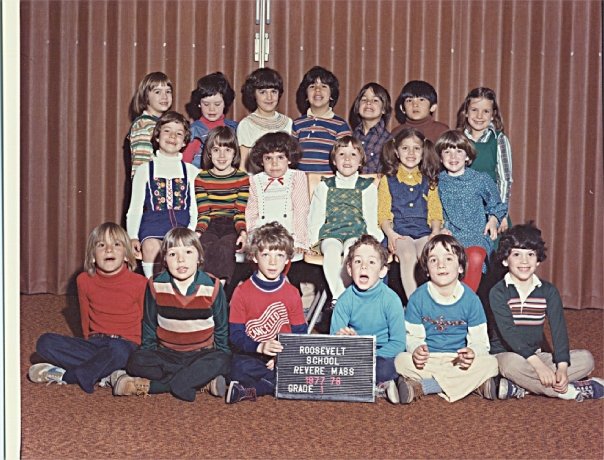
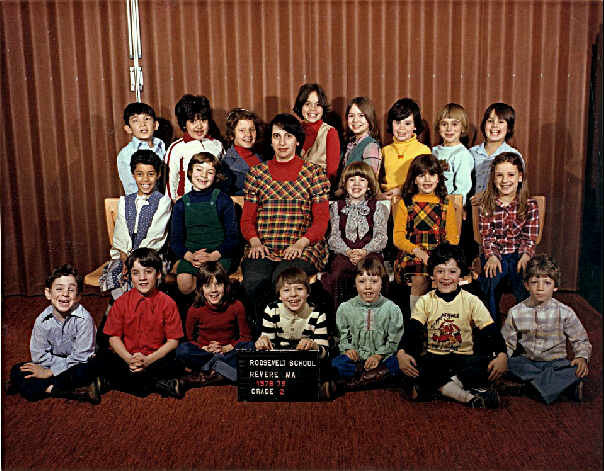
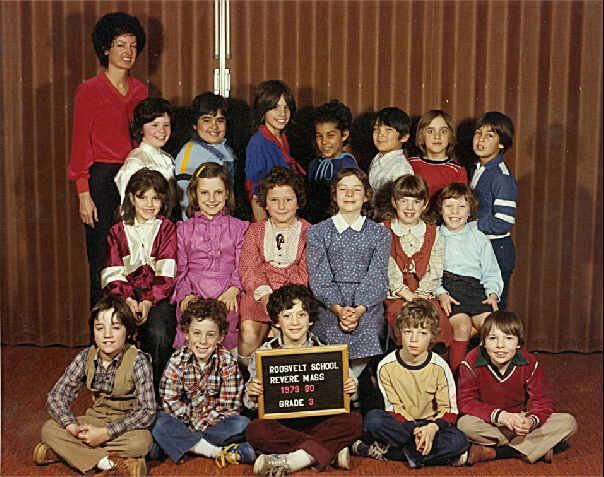
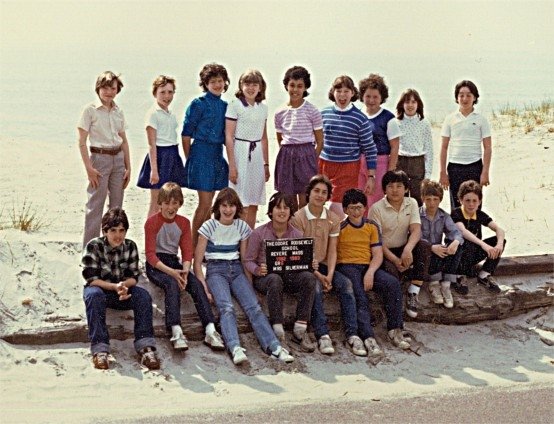
Well, my old elementary school friend Myles Lynch posted some class pics on Facebook that show the physical impact. Looking at them brings back memories good and bad.

Let’s start with first grade, before the disease surfaced. I’m dead-center in the back row, looking like a normal kid:

2200_1068435840811_6597_n

By the time the second-grade class photo is taken, I’ve been diagnosed with Crohn’s Disease and I’ve spent six weeks in the hospital. The results of the Prednisone on my face are pretty clear. I’m second from left in the back row:

648_1068081391950_656_n

By the time the third-grade pic is taken, I’ve been through my second flare-up and six-week hospital stay. I’m in the back row, two kids to the right of the teacher, Ms. Cole:

648_1068081831961_374_n

I’m not in the fourth-grade class picture, because as the photo is being taken, I’m in the middle of a third six-week hospital stay for another flare-up. The disease usually struck sometime between Halloween and Thanksgiving. This time, it waited until spring.

By sixth grade I’ve been off Prednisone for a while. You can see it in my face, front row, far left:

2200_1068435800810_6378_n

The other kids in these pictures have had their own challenges and joys in life. I’ve kept in touch with some of them. But here’s the important thing: Back then, when we were a small, close-knit community, before the puberty-driven bullying of middle school, these kids did all they could to make me feel better. When I was in the hospital they would send hand-made get-well cards. When I’d get out of the hospital, they would give me a warm, cheerful welcome back.

Those acts of kindness are something I will never forget.

The pictures also remind me a lot of what life was like in the hospital. Those hospital wards were like little communities, where the young patients would try to find ways to pass the time. We shared each other’s toys and watched the same TV shows. I always seemed to be the only Crohn’s patient on a floor full of kids with Cystic Fibrosis. Treatment for that disease was nothing like it is today, and many of the friends I made in the hospital died before they got to adulthood.

I lost a lot of blood back then, because I had a colon full of holes. But compared to my lost friends, I got off lucky.

I owe that to God and all the helpers he put in my path.

Whenever I’m having a bad day and I start to get cranky and impatient with people, I try to think back to those days. Doing so makes me remember how blessed I am, and how I should stop wasting time on hard feelings and earn that blessing by spending my life as one of those helpers.

I’ve been walking past Children’s Hospital these days on the way into the neighboring hospital my father has been in since suffering a stroke last week, and the memories come flooding back of the time when I was a frequent resident there. And seeing my father, with his eye patch and slackened mouth, makes me remember the things he used to do to keep me going.

During one stay, I was obsessed with getting a talking View-Master, where you put in these paper disks and look through a view lens at the scenes that blow up larger than life on a screen inside the gadget. The taking variety was all the rage in 1979, and I bellowed about it like the spoiled brat I was. You get very spoiled and miserable to be around when everyone is tending to your every need.

My father got me the talking View-Master, and bought me a new Star Wars action figure each week, followed by a trip to Friendly’s for ice cream on those occasions where I was allowed to have it.

The more emotional variety of affection was something he always struggled with, though in his way, he was doing all he could to show his love.

Amazing, the things that come back to you after looking at a few childhood pictures.

For Veterans, A Holiday Here and There Isn’t Enough

Funny thing about holidays where we honor veterans: Everyone puts those who have fought for our freedom on a pedestal for the day, then the next day some of us go back to treating the same people like garbage.

Mood music:

http://youtu.be/V-zqIS7vWbY

Flashback: September, 2010: I’m walking the streets of Brooklyn on a beautiful night, and a guy comes up to me. He has a hole in his head where his left eye used to be and burn scars up and down one arm.

I’m smoking a cigar, so he approaches me for a light. He tells me he was maimed in Afghanistan during military service and asks for some change so he can get a train to somewhere. He tells me he’s in New York looking for work and was stranded without money.

I give him the change from my pocket and then he’s gone.

Is he telling the truth? I have no idea, and I don’t really care. He just looked like a guy in pain who needed a few quarters to survive the next few hours, and that’s all that mattered at the time.

Flashback: Late April, 2011: I’m on Facebook one afternoon and I see a friend commenting that he’s disappointed that some of his friends have decided to “like” a page that makes fun of a fellow known in Haverhill, Mass., as Crazy Mike.

In any city there’s a guy like “Crazy Mike.” The stereotype is usually a long beard, ratty clothes and the fellow is usually living on the street. He talks aloud to no one in particular and falls asleep on playground equipment. People like to laugh at him.

A lot of these so-called crazy guys are homeless vets whose luck ran out somewhere between the battlefield and the hard re-entry into society.

After a few seconds of thinking this through (admittedly, a few seconds is never enough time to really think things through), my temper reaches full boil and I pound out a blog post called “Liking The Crazy Mike of Haverhill Page is Sad and Stupid.”

Discussion follows online, with a big question being if Crazy Mike was in Vietnam and, as a result, sick on the streets with Post-Traumatic Stress Disorder. One reader insists he is indeed a veteran, and that other homeless people keep stealing his medication. Someone else says she knew the family fairly well, and that Mike is not a veteran. He’s simply a guy who has a serious mental illness.

To me, it doesn’t matter if he was in Vietnam or not. Instead, two realities have my mind spinning like a top on fire.

One is that a lot of people assume he is a veteran, but treat him like shit anyway.

Another thing is that there are a lot of homeless who ARE military veterans, and most days we don’t give them more than a few seconds of thought before we walk on by.

It’s almost as if we honor them on holidays to make ourselves feel better about being the assholes we often are.

I say this as a guy who is admittedly one of those assholes. I’ve made my share of fun of people like this, and in the rear-view mirror, looking back at my own struggle with mental illness, it makes me feel ashamed.  Back when fear, anxiety and addiction had me by the balls, I used to walk or drive the other way when these guys approached. It makes me the last guy on Earth who would be fit to judge others for poking fun at someone less fortunate.

It would be high-minded of me to say we need to do better for our veterans. But it’s been said so often it’s pretty much lost it’s meaning. We like to praise our veterans on Veterans Day, Memorial Day or July 4. But once the holiday is past, we go back to our normal behavior. Because they’re homeless and, as a result, they’re dirty, scary and unpleasant to those who have lived far more comfortable lives. And, don’t you know, we LOVE to judge people even though we know nothing about them.

Let’s face it, folks. We need more than the occasional holiday to treat these people the way they deserve to be treated.

And with that, we can all go back to our holiday cook-outs.

Fear of Coming Clean At Work

No, not my fear. I came clean about my fight with OCD a long time ago and my work colleagues are nothing but supportive. At this point, my life is an open book. But for those who are at the other end of the spectrum, I came across an article that might help.

Mood music:

http://youtu.be/bWsYuW9ULdU

It’s an item on About.com from Dr.  called “OCD and Work: Dealing With Employers.” There was a time when I lived in dread over whether or not to come clean. For one thing, there was a time when my disease was impacting my workmanship. I was a control freak in an environment where I had no control. That period of my life is best captured in a post called “One Of My Biggest Regrets.”

But that was long before I got the treatment I needed. Through years of extensive therapy, medication and tackling other disorders, I’m at a point of no return. I may backslide from time to time. I do, in fact. But there’s no going back to the insanity of 2000-2006. I’ve simply learned too much.

But for those just beginning to deal with their demons, the question of what to do about work is a big one — maybe even the biggest. You want to get well and do so in an honest way, but how many times have we heard about workplace discrimination? I hear about it all the time.

Dr. Kelly’s article is an excellent first step in knowing what to do.

He writes:

Choosing to disclose that you have OCD to a potential or current employer can be terrifying. People in this position often:

  • wonder if their potential or current employer will be supportive, reject them or even know or understand what OCD is
  • fear being passed over, fired or forced out through attrition
  • worry what people around the office will think
  • worry that they’ll regret their decision
  • fear being blacklisted within the industry they work
  • fear not being trusted with important tasks or responsibilities

It is important to know that if you are in this position, there is no right answer and that you need to weigh this decision for yourself.

The best part of the article is when he gets into what you should do IF YOU DECIDE TO COME CLEAN.

He writes:

If you decide that benefits outweigh the risks and you decide to disclose that you have OCD to a prospective or current employer, it will be up to you to make sure that your employer understands the nature and severity of your symptoms. This this doesn’t mean that you need to tell your boss everything — just what she needs to know and what accommodations you might need. If your employer does not fully understand the challenges associated with OCD, or doesn’t even know what it is, it may also be helpful to educate your employer about your illness. It may even be possible to enlist your health care provider to advocate for you.

Finally, check and see if your employer has retained the services of an employee assistance program or EAP. This service may be able to assist in or facilitate disclosure of your OCD to your employer.

An important part of the article is near the beginning, and deals with your rights. Kelly notes that it’s illegal to discriminate against someone because of a medical condition, including OCD. A final excerpt:

 if you are otherwise qualified for the position, you cannot be denied employment simply because you have OCD. Although the law is quite clear on this, the actual experience of prospective and current employees with OCD can unfortunately be quite different.

However unfair, there is actually quite a bit of incentive for employers to terminate or pass on hiring someone who they know has a chronic illness — mental or physical. On average, their health costs will be higher; they will be absent more days; and they may even have to go on long-term disability leave — all of which impacts the bottom line.

Although it is illegal to terminate someone on the basis of a medical condition, there are many ways that employers can accomplish this indirectly. For example, the employer can give the employee progressively more undesirable tasks until to the employee decides to leave.

This article is something I wish I had back in the day. It’s probably the best direction I’ve seen anyone give people facing the question of disclosure.

I hope this helps. Good luck.

Why This Day Will Not Suck: May 25

Every few months, I try to step out of the craziness of daily life and take stock in my life. The struggles will always be there, but I have so much to be grateful for. With the sun finally shining bright after a long stretch of bad weather, I’m feeling like nothing can keep this from being a good day.

Mood music:

–Whatever this day hurls at me, I have a lot of people in my life to help me along. I wrote about some of them in two earlier posts: The Healers (Adventures in Step 9) and The Gratitude List, which begins with Erin and our children. Erin has been waking up at the same time as me to get a better jump on the day, and I love that I get to give her a kiss and wish her a good day on the way out the door.

–I got to see the sunrise on the drive to work. Fellow Bostonians who have lived through a week and a half of shitty weather will understand why this makes me feel ready to take on the world.

–I just got an email in our family finances account for Staples coupons, which beats the hell out of billing statements.

–I’m loving the hell out of the new Sixx A.M. album. A friend was kind enough to burn me a copy and I can’t stop listening. It’s truly a celebration of life. I can’t wait to get the book that goes with it, “This is Gonna Hurt.”

–I put on a pair of jeans this morning that just went through the wash. It used to be that when I washed pants, I couldn’t get them buttoned afterwards. Now they button easily.

–Once again, I get to spend the day doing a job that I love. It’s exceptionally hard to find a job like that, and I know full well how blessed I am.

–The Cub Scouts went fishing last night, and Sean was able to reel in a fish before a thunderstorm rolled in and cut the evening short.

–When I got to the office the Teddy Roosevelt bobblehead on my desk was doing it’s thing without having to be tapped. It could mean the office is haunted, but I choose to look at it as a good omen.

–I got a mug full of Jet Fuel coffee.

–My laptop let off a series of ominous beeps and needed a couple restarts. This could seriously fuck up a work day, but it’s working fine now.

–A three-day weekend is ahead and the kids are going camping. This leaves me and Erin with some much-needed quality time.

Seize the day.

What’s YOUR Insanity?

“Paint a garbage can platinum and underneath, it’s still a garbage can.” Nikki Sixx

In Chapter 3 of the AA Big Book, we’re introduced to an alcoholic named Jim. He has a successful business until he starts drinking at age 35 in an attempt to dull a nervous tick, and everything goes to hell.

From pages 35-36:

“In a few years he became so violent when intoxicated that he had to be committed. On leaving the asylum he came into contact with us.

“We told him what we knew of alcoholism and the answer we had found. He made a beginning. His family was re-assembled, and he began to work as a salesman for the business he had lost through drinking. All went well for a time, but he failed to enlarge his spiritual life. To his consternation, he found himself drunk half a dozen times in rapid succession. On each of these occasions we worked with him, reviewing carefully what had happened. He agreed he was a real alcoholic and in a serious condition. He knew he faced another trip to the asylum if he kept on. Moreover, he would lose his family for whom he had a deep affection.

“Yet he got drunk again. We asked him to tell us exactly how it happened. This is his story: “I came to work on Tuesday morning. I remember I felt irritated that I had to be a salesman for a concern I once owned. I had a few words with the boss, but nothing serious. Then I decided to drive into the country and see one of my prospects for a car. On the way I felt hungry so I stopped at a roadside place where they have a bar. I had no intention of drinking. I just thought I would get a sandwich. I also had the notion that I might find a customer for a car at this place, which was familiar for I had been going to it for years. I had eaten there many times during the months I was sober. I sat down at a table and ordered a sandwich and a glass of milk. Still no thought of drinking. I ordered another sandwich and decided to have another glass of milk.

“Suddenly the thought crossed my mind that if I were to put an ounce of whiskey in my milk it couldn’t hurt me on a full stomach. I ordered a whiskey and poured it into the milk. I vaguely sensed I was not being any too smart, but felt reassured as I was taking the whiskey on a full stomach. The experiment went so well that I ordered another whiskey and poured it into more milk. That didn’t seem to bother me so I tried another.”

This is what we addicts call insanity. We get into this stupid idea that we can drink, eat or do drugs in perfect moderation like so-called normal people. That might mean trying to moderate drinking by ditching the hard stuff for just beer, or ditching red meat.

In the former case, you’re still getting smashed on a daily basis on beer. In the latter case — my case — you binge on everything that isn’t red meat until you explode.

At one point in my time as an out-of-control food addict, I decided to starve myself during the week and allow myself crazy binges Thursdays through Sundays. I looked forward to Thursdays because I could go into the Ground Round and order one of those colossal plates of nachos with every kind of junk dumped on top. That’s an appetizer meant to be shared between three or more people, but I would eat that myself, then chase it down with something healthy like a salad.

I’d carry on that way until the end of the weekend, and work out an hour-plus each day to balance it out.

It was but one variation of the insanity I had always practiced. As a teen and early 20-something I would binge on fast food for weeks and then starve myself for one or two weeks.

I usually binged in the car, trying to drive as I stuffed one arm into the bag of grease, flour, sugar and salt. That’s insanity too, because it doesn’t exactly promote safe driving.

It’s all about as crazy as putting whiskey in your milk and carrying on like you’re just drinking milk.

In the big picture, the problem isn’t the food, or the booze, or the drugs. It’s not necessarily the insanity of engaging in the binge.

Instead, the real problem — ground zero — is a deeper insanity that takes up residence in our souls, causing us the nervous ticks that make us do the stupid things we do. In the TV show “The West Wing,” recovered alcoholic Leo McGarry describes the nervous condition nicely:

[youtube http://www.youtube.com/watch?v=DUwm6WJRPIQ&fs=1&hl=en_US&rel=0]

We all have some form of insanity within us. Some learn to manage it without substances. Many more don’t.

Which leaves me with the question:

What’s your insanity, and what does it make you do?

Talk About The Weather

New England has been mired in a soupy, cloudy, downright dreary weather pattern for most of the last week or so. We were teased with sunshine Saturday, only to be tossed back under the clouds Sunday. For someone prone to mental illness, this is hell.

Mood music:

Like most people with mental ticks, too much of this weather is bad for my well being. It throws me into a prolonged period of discouragement and depression. All I want to do is fall asleep in my chair, but that’s not possible most of the time. It becomes a lot harder NOT to binge on the things my addiction craves.

These days, the depression part sneaks up on me, whereas before it was much more transparent.

Last week I thought I was holding up pretty well. Things were especially busy at work and I threw myself into it. I normally do that anyway, but with the clouds thick outside, I did it with extra zeal. The thinking is that if I stay busy I won’t notice the gray outside. As a kid, I used to do something vaguely similar, trying to go to sleep as a hurricane or thunderstorm approached so I could just sleep through nature’s fury.

This past winter was particularly vicious, and it hit me hard. I didn’t realize it in real time. It sort of smoldered beneath the surface until it blew up in my face in mid-February.

Something similar has happened this past week. It hasn’t blown up in my face, but by week’s end it occurred to me that I wasn’t at my best.

I was quieter at home. I had less patience with the kids. 

With the sunshine Saturday, I sat on the back deck for 2 hours and tried to sop up as much of the solar energy as I could. I knew I needed to resupply — and fast.

Sunday, when the clouds rolled back in, the progress of the day before seemed to have been erased.

I’ll get through it. I always do.

But if you’re feeling blue or discouraged, it’s not just you. I suspect a lot of people in N.E. feel like me this morning.

The key is to get through it without binging or letting the important things slide.

So far, I think I’m doing OK with that.

But the sooner the sun comes back, the better.