When Sick is Good

This was one of those weekends where sickness ran through the house.

Duncan threw up all over the place Friday night and was down for the count most of Saturday, as was I. Sunday it was Sean’s turn. During a birthday party at a friend’s house, he threw up all over their living room floor. Luckily, the living room isn’t carpeted, so clean-up was easier than it otherwise would have been.

The point of mentioning this is that once upon a time, before I learned how to manage the OCD, puking kids would have unhinged me. It did unhinge me.

First, I would freak out about the mess and go into total OCD overdrive. I would be rendered all but useless over such things.

Not just because of the mess, but because of the tendency I used to have to let my mind spin out of control with worry — worry that something really bad might happen to my kids.

This kind of thing still leads to compulsive behavior, even with my mental health in better shape. In the summertime, I’m still a stickler for bombing the kids with bug spray before letting them play out side. Fear of the EEE virus is a big motivator.

I also think some fears are justified, and I’ll keep acting on them. The bug spray is an example of that.

But otherwise, I’m now able to keep my sanity together when the kids get sick. I clean up the mess and move on. And in a weird way, the weekend was rather nice because of the sickness.

It forced us all to slow down — something we’re not very good at.

Duncan and I watched TV all morning, resting comfortably beneath blankets. Today, Sean will do the same.

I’ll be a cyclone of hyperactivity halfway through today, but it’s also good to know I don’t need as much lying around as I used to.

Strong Arm Of The Log

The author admits he stole the title for this entry from an old North Shore Sunday article because, well, he thought it was cool.

See the bald guy at the front of the picture above? That’s Mike Strong, an old friend of mine from the college days. I look up to him today. But there was a time when I hated his guts.

I met Mike back in 1993 at Salem State College. We were both writing for the college paper, “The Log.” We got along swimmingly at the start, as we had things in common. I was from Revere. He was from neighboring Lynn. We both spoke the same salty language.

But something strange happened that first year.

The editor-in-chief position at the paper was filled by election. Mike was running. So was a guy named Mike Murphy, a young-Republican type who was a member of the Student Government Association.

At the time, I was making friends in both camps. But the two camps were distrustful of each other. The path to disaster was paved.

On election day, I voted for Murphy. Truth be told, I did it because I was chummy with him and my brain was conflicted. I regretted the choice from the moment I put the vote in the ballot box. No disrespect for Murphy. I just realized I voted based on friendship and not who was best qualified.

My vote put Murphy ahead. The then-editor-in-chief had the brilliant idea of opening the ballot box mid-day to see how the vote was going. Murphy was ahead. The editor-in-chief decided Murphy would be a disaster and decided to rig the election in Strong’s favor.

He got caught, of course. Another election was held, and this time Strong came out on top. I voted for him this time. But by then, most of the staff were suspicious of my first vote, especially Strong. I guess that meant my being elected managing editor was a laughable thing. There was no way Strong was going to trust me as his managing editor. I didn’t blame him.

The next semester started out as rocky as I expected it would. Truth be told, I was slacking. I was enjoying that I held the position. But I was doing nothing to earn it. Mike eventually called me on it. I resigned and decided to focus full-throttle on writing and reporting.

At that moment, the relationship changed. Over the course of the year, our friendship deepened.

He was a harsh editor. He would toss stories back at you and tell you it needed work. That’s where the North Shore Sunday reporter who wrote about The Log came up with the “Strong Arm of the Law” headline. I don’t thing Strong liked the headline very much. I thought it was excellent.

The article described a revolving door of students who would come in wanting to write, only to flee in frustration soon after because they couldn’t handle the Strong treatment.

I thought it was funny, in part because I knew it was exaggerated. Sure, a lot of students couldn’t handle it, but a lot of students could and did. And they became attached to the Log office and Strong himself.

It’s funny we would be so attached to that office. The place was filthy and constantly smelled horrific because of a leaking grease pipe in the ceiling above that ran from the campus cafeteria.

As a reporter, I dug deep into Student Government affairs in search of corruption. I poured over financial records and made much of a couple junkets members had gone on. Strong kept on me during that story, settling for nothing but ironclad reporting. In the space of 2 weeks, I gained 15 pounds and was waking up in the middle of the night with flop sweat.

You might say that was an early sign of one of my OCD quirks — making myself rabid in the effort to be a people pleaser. I’m glad I got over that habit.

After graduation, Strong and I were in and out of touch. In the last couple years we have been in constant contact, thanks to the miracle of Facebook.

Mike has gone on to do wonderful things. He’s the director of Par Fore the Cure, an organization that, according to its website, does the following:

We honor the lives of those who have succumbed to brain tumors (and, by extension, all cancers) and offer hope to those still affected by cancer. We raise awareness and fund research through contributions to the Jimmy Fund. We run our events efficiently, ensuring our annual donations increase while our guest costs remain affordable. To date we have donated more than $265,000 for brain tumor research at the Dana-Farber Cancer Research in Boston.

Strong’s tireless drive keeps this machine humming smoothly along, and in the process lives are being made better.

We also have Faith in common. Both of us have become devout Catholics, and share stories of our Faith frequently.

I’m not sure I have a point for this tale. I guess he was on my mind because we’ve been talking a lot in recent days about the special Senate election to fill Ted Kennedy’s seat. He’s pushing hard for Scott Brown.

Friends like him give me the inspiration to press on when I’m feeling down. As a result, I’m feeling Up much more often.

The Mood Swing

Back in the day, when I was throwing parties in the basement of my house in Revere, Mass., I would reach a certain level of intoxication around 2 a.m. where I’d freeze in place, yell “mood swing!” and throw candy and other food items around the room.

People seemed to enjoy it, so I kept doing it. Even then, the ego was there.

Looking back, I now know that those mood swings, which were real, were the beginnings of some mental damage.

To this day, I experience it, even with the Prozac.

I can wake up in a perfectly good mood. Then, two hours later, a wave of melancholy will hit me for no good reason. Then I listen to some angry music and it eventually passes. Other days I’ll wake up with a feeling of dread for no particular reason and an hour later the mood turns sunny and I’m ready to take on the world.

It’s been happening more frequently in recent weeks, which I’ve come to realize is the winter effect. Minimize my sunlight and throw a lot of cold, gray weather my way and it gets a little tougher to hold it all together.

I started taking an extra 20 MG of Prozac last week, the idea being that I take a higher dosage for the duration of winter and dial it back to where it was come spring and summer.

It’s just starting to have the desired impact. The mid-afternoon mood swings I was having last month have gone away. But I still get up on a morning like this one, where I feel the brooding impulse for no particular reason.

And so I put on music like this:

[spotify:track:2yWOMbhPN2XJAiVy46Bhvz]

And now I feel better.

That’s how it works.

A tricky thing to manage, but it’s much, much better than it used to be. For that I Thank God.

Sarcasm or Gallows Humor?

It’s appropriate to start with Dilbert’s take on the topic at hand:

[youtube=http://www.youtube.com/watch?v=CO1UWmRS7yc&hl=en_US&fs=1&]

My wife just read my post on the Power of Sarcasm and decided to go digging for the actual definition. She’s an editor. That’s what she does.

Here’s what she found:

“Sarcasm” is “a keen or bitter taunt : a cutting gibe or rebuke often delivered in a tone of contempt or disgust” or “the use of caustic or stinging remarks or language often with inverted or ironical statement on occasion of an offense or shortcoming with intent to wound the feelings.”

She pointed out that I’m not really a bitter person, and that my jabs are playful. So why bring myself down in the gutter and suggest I’m a bad person when I’m not?

In the comments section of that post, she wrote:

Why you say the off-color remark is as important as what you say. If the intent is to show your contempt, to point out an offense, or to hurt someone, you are being sarcastic.

But if your intent is to make light of a tough situation as a release, not to wound, that seems to me to be more of a black humor: humor marked by the use of usually morbid, ironic, grotesquely comic episodes.” It may be something else altogether as well; I won’t pretend to be an expert on humor and all its vagaries. But I do sense different emotions and intents behind different humorous responses.

Sarcastic seems very mean to me (esp. in light of the definition above) and a very different thing from a gentle teasing, not meant to wound at all.

Fair point. I would definitely describe mine as a dark humor. Or Gallows humor. Sarcastic when I’m in a bad mood, perhaps.

As I said before, sarcasm is also a root of dysfunction in other parts of my family. Several of my family members are equally sarcastic, if not more so. But I sometimes get offended by it because I feel like people are laughing AT someone instead of laughing WITH them. This has produced a fair share of strain on that side of the family, and I have to claim fault on my end.

I described it as hypocrisy on my part in the last post. But if one is to take these definitions in their purest meaning, maybe I’m not being hypocritical after all.

Which means I’m now free to unleash even more sarcasm. Or dark humor.

Revere Revisited

I recently drove through my old neighborhood, the Point of Pines in Revere. Much has changed, some good, some not so good.

Mood music:

[spotify:track:5buAcoMYgdr4sCtuYiIXKs]

Let’s start with the house I grew up in. It seems to sag a lot more than I remember. The bushes that covered the concrete patio are gone, but the huge birch tree on the front lawn is still there. Always loved that tree.

A lot happened in this house. The memories of being up all night in the bathroom as disease ripped through my insides is still fresh. So are the memories of the house being crammed with people right after my brother’s death. My parents fought a lot here, and we had to abandon the place for a bit during the Blizzard of 1978. The National Guard evacuated us. I’d like to say it was cool, but the truth is I was pretty scared.

Some good things happened here, too. As a teenager I had the entire basement apartment to myself. I threw parties, smoked to my heart’s content, and found some refuge. The downside was that every time a coastal storm came along I had to worry about the ocean flooding out my domain.

The condominiums they started to build behind the house in the 1980s was eventually completed. It sat unfinished for years, and I used to enjoy throwing rocks through the windows from my backyard. I’m not sure the neighbors liked it so much.

They shoved a couple other condos and townhouses in corners of the neighborhood I never would have thought big enough to build upon. Yet someone found a way.

The small, white Catholic Church closed down, was split in two and turned into a couple over-sized, rather ugly houses. The park is still the same. It looks pretty much the way it did back in the day, except for a bit more graffiti on the playground equipment.

Leaving the neighborhood and driving up Revere Beach Boulevard, I noticed the parking area on the beach side had been done away with, replaced by a sidewalk. No more of people parking and hanging out on hot summer nights, but I’m sure the residents like it better that way.

Driving up Revere Street, I noticed the Paul Revere School had been torn down and was being replaced with a new school. Good thing, too. That place was falling apart when I attended junior high there. I still remember the smell in the basement, where the cafeteria just happened to be. It was not a pleasant smell.

My dislike for the place also stems from being there during some tough times. No offense to those who taught there and studied there. Many of them are good friends today.

Squire Road is pretty much the same, though the Pewter Pot was torn down and replaced with what I think is a furniture store. The Kentucky Fried Chicken burned down at some point.

It’s nice to visit the place once in awhile. I certainly love the people.

But Haverhill is home now, and I wouldn’t have it any other way.

Revere is where I survived.

Haverhill is where I healed.

Things That Make Me Laugh

Early in the life of this blog, I wrote about humor as one of my most indispensable OCD coping tools in “Laugh It Up, Fuzzball.” I expanded on it Monday in my “Power of Sarcasm” post. Today, I have fresh humor to share.

A never-ending source of laughter is my kids. Every day they say things that make me wonder where the hell they came from. They came from God, of course, and they definitely get their brains from their Mom. I admit they get some of their bathroom humor from me. What can I say? I did grow up in one of the reigning capitals of bathroom humor. And I worked in a record store where we often used toilet humor to pass the time.

Anyway, the kid example:

Item: Duncan comes running down the stairs red-faced. “What’s the matter?” I ask. Duncan says, “Sean called me cupcake!”

Item: Annoyed at the effort I have to make to get the kids out of bed on time, I decide to turn on the old-fashioned, bells-on-the-top alarm clock on their nightstand. It goes off on queue, to Sean’s dismay. Sean says, “Dad, don’t ever turn that thing on again. It rattles my brain and makes me cranky.”

Item: Duncan, when asking for a cheese sandwich, tells me I can use any kind of cheese except for the “cheese wedgies” (he meant cheese wedges).

Item: Erin expresses her dismay one afternoon over the inability of the three boys in her house to have their coats and shoes on in time to leave for an appointment. Sean responds: “Well, we are the Baloney Boys.”

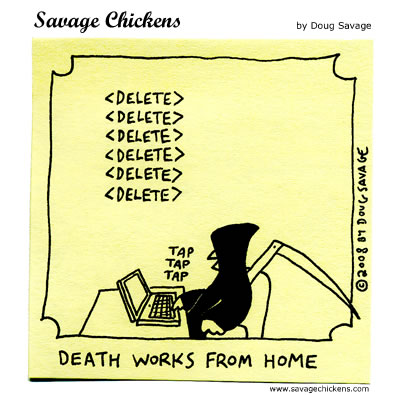
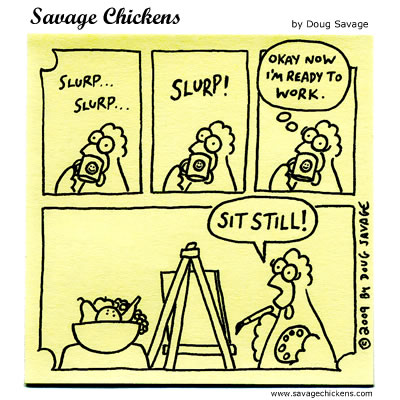
Another source of laughter is a relatively obscure comic series called Savage Chickens, penned on post-it notes by Doug Savage. Here are two favorites:

Savage Chickens - Death

Savage Chickens - Coffee Is My Muse

Then there’s the FakeAPStylebook, which I follow on Twitter. Here are some gems:

Putting a lowercase “i” in front of capitalized words in stories about Apple is iDiotic.

When interviewing Satan remember that he is the Prince of Lies and will tell you his name is actually “Heywood Jablomi.”

All scandal names should end with the suffix “-gate,” as all scandals center around the Watergate complex.

“Catwoman” is the Batman villain. “Cat Woman” is your neighbor whose apartment smells funny.

I saved the movies for last, because pointing to funny films is the typical thing to do. But they are important, so here we go…

I tend to get the biggest kick out of the dark humor. I guess it hits me where I live. But then there are movies that make fun of other movies. “Spaceballs,” anyone?

[youtube=http://www.youtube.com/watch?v=aElFcPMZHVo&hl=en_US&fs=1&]

Con Air is universally panned as a bad movie. But I love it. Cheap explosions. Bad dialogue. Bad is funny when done right.

[youtube=http://www.youtube.com/watch?v=px1W7ZOv3mA&hl=en_US&fs=1&]

Johnny Dangerously was panned as well. But it’s one of my favorites. How can you go wrong with Roman Moroney?

[youtube=http://www.youtube.com/watch?v=6GVCgTFw2Qk&hl=en_US&fs=1&]

There’s plenty more, but it’s time for me to go write about information security

Rockit Records Therapy Session

The author has mentioned Metal music as one of his most important coping tools for OCD and related disorders. Here’s a look at the year he got one of the best therapy sessions ever, simply by working in a cramped little record store.

Back when I was an angst-filled teenager bent on self-absorbed periods of depression — and before I became an angst-filled grownup bent on self-absorbed periods of depression — it was a place where I could escape.

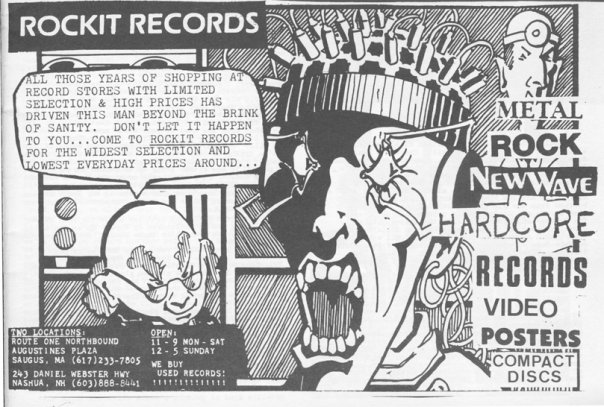
Located off of Route 1 northbound in Saugus, Mass., Rockit Records was literally a hole in the wall, not much bigger than a walk-in closet. It later expanded in size, but even then it seemed small. But the sounds booming from speakers above were always big.

It was the perfect safe house.

Now that someone has started a “Remembering Rockit Records” group on Facebook, the memories are flooding back.

There’s no real lesson in this post. Just a happy memory. Like any retail job, there were some unpleasant people and hours to contend with. It wasn’t perfection. But it wasn’t supposed to be.

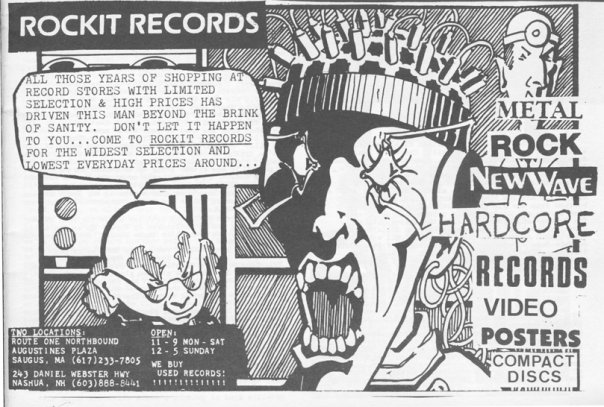
Here’s an ad for the store from the early days:

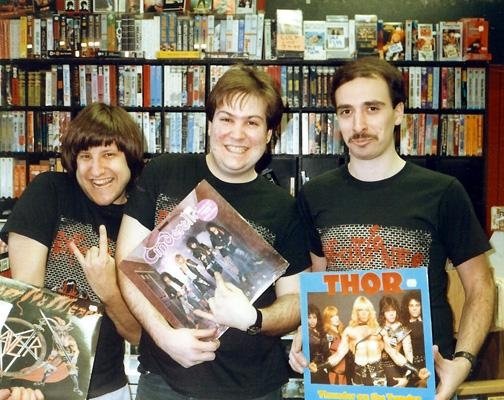
And in this picture, on the left, is Al Quint, my former boss:

Al is still going strong, producing the Sonic Overload radio show and publishing his Suburban Voice magazine in blog form.

The store was crammed with cassettes, vinyl and eventually CDs. You could sell and buy used music. You could buy all the hard-to-get metal fanzines.

True story: On Aug. 3, 1987, I was the first kid in the store to buy Def Leppard’s just-released and long-awaited “Hysteria” album. The band was already spinning in a downward spiral toward candy-coated pop. I just didn’t realize it at the time. And in those days, I was a BIG Def Leppard fan.

A year later, I believe I was the second or third kid to buy Metallica’s “And Justice for All” album.

In 1992, just as I was transfering from North Shore Community College to Salem State College, a job opening became available and I applied on the spot. I thought the place was so cool at the time that  such a job was beyond my reach. No way they’d hire me. I wasn’t covered in tattoos or wearing nose and ear piercings. All I had going for me was the long hair, I thought.

But they called me in, and Al confirmed to the owner that I was a longtime shopper. They hired me, and I worked there for the next year, until new owners took over and I had decided to get too serious about my journalistic studies to work a retail job.

It was a tough year in a lot of ways. A family member was beginning to sink into some serious clinical depression and a suicide watch was on. I had turned North Shore Community College into a refuge of sorts, hiding for hours in the smoking room of the Lynn campus instead of facing my demons at home. I was uneasy about transferring to Salem State, though it turned out to be the best decision I could have made.

So for a year I manned the register as all my old school friends came in to shop. We smoked cigarettes at the front door and sometimes smoked other things out the back door. If we wanted a pack of smokes or something to eat and were short on cash, we borrowed from the register, putting index cards in place of the missing cash with such notes as “Bill borrowed $5, will return Thursday.”

I’m still not sure how we got away with that. It was a different time, I guess.

There was an Italian buffet restaurant across the parking lot called Augustine’s. The food wasn’t very good, but for a binge eater like me it was perfect.

If we liked the music that came in we would play it constantly. House of Pain was in the CD drive a lot. So was the Henry Rollins Band. Sometimes we’d get in promos for not-yet-released albums. If the staff didn’t like what they heard, the CD would quickly be converted into a Frisbee we’d whip across the store. One of the Poison albums suffered this fate.

I’m not sure if Al or the owner knew this was happening, but I wouldn’t be surprised if they knew and tolerated it.

The owner eventually sold the place and that essentially meant I was out of the job. I wasn’t exactly in the new owner’s good graces. But by then, it was time for me to move on.

I recently drove by the old shopping strip and noticed a Subway sandwich shop where Rockit Records once stood. A pity, really. But a lot of music stores suffered the same fate as the iTunes age dawned.

For me, it served its purpose. A jewel of an escape closet from a world of hurt.

Luckily for me, I’m finding people I worked with on Facebook. Now there’s the Facebook group.

Which means Rockit Records isn’t really dead, now, is it?

The Power of Sarcasm

The author explains why humor wrapped in sarcasm is one of his favorite coping tools — even though the edge of the knife can be too sharp at times.

“If you can’t say something good about someone, sit right here by me.”

The quote is from Alice Roosevelt Longworth, eldest daughter of President Theodore Roosevelt. She was 96 when she died in 1980, and I can’t help but believe that part of her longevity was her legendary sarcasm.

For me, sarcasm is a mental release that allows me to see the humor in some of life’s bigger challenges. Of course, the danger is that sarcasm can sometimes slide into outright rudeness, and I’m sure I’m guilty of that at times.

Here’s how it works:

If people in the family, office or church community are butting heads, you can easily get caught up in what one person is saying about the other. After awhile, you can grow bitter and that will compromise your ability to do your job or be the family member you should be. That’s the danger with me, anyway. But the sarcastic, gallows humor in me will instead look at those situations and find the lightheartedness of it all.

We’re all dysfunctional to some extent and we all screw up. And let’s face it: Sometimes it’s fun to watch. If you can laugh at someone’s quirks and, more importantly, laugh at your own, it’s easier to move on to other things. Easier for me, anyway.

The alternative would be for me to grow bitter to the point of incapacitation. It’s happened before, especially after I realized managing a daily newsroom at night wasn’t fun anymore. I took every criticism as a knife to the core and my workmanship slid steadily downhill. A healthier sarcastic perspective back then would have helped me through that.

I’m sarcastic toward a lot of my friends and family, especially the in-laws. The truth of the matter is that I’m almost always sarcastic toward the people I like. Most of them get it and give it back in equal measure, including my father-in-law and kid sister-in-law, who probably gets the heaviest, most ferocious dose of my brand of humor. Both brothers-in-law are regular targets as well.

I’m finding that the kid sister-in-law’s boyfriend is skilled in the art of sarcasm. At a family event this weekend, I joked to those eating a salad I made that I didn’t wash my hands first.

“You should write a blog post about why you don’t wash your hands,” he deadpanned. Avoiding hand-washing as an OCD coping tool. I like this guy.

When I’m not sarcastic, family and friends ask if I’m feeling ok. A lack of sarcasm becomes a warning sign. For normal people, this usually works in the opposite direction.

Of course, sarcasm can sometimes work against you.

If you don’t catch someone on a good day, hitting them with sarcasm does more to hurt than to lighten the mood.

Sarcasm is also a root of dysfunction in other parts of my family. Several of my family members are equally sarcastic, if not more so. But I sometimes get offended by it because I feel like people are laughing AT someone instead of laughing WITH them. This has produced a fair share of strain on that side of the family, and I have to claim fault on my end.

If you can direct sarcasm toward someone but get offended when it’s being sent in your direction, that’s hypocrisy. It’s a hypocrisy I’m sometimes guilty of.

I’m working to minimize that.

But don’t expect me to change too much. As I said, sarcasm is a release. It’s a tool that keeps me sane.

And isn’t it better for all of you if I’m  sane?

Even Dobermans Get The Blues

I’m taking Sunday off from writing on here because some of my readers say they need to catch up. But I can’t resist sharing this article, flagged by my good friend Ann Ball, about how dogs battle a little of their own OCD.

Guess I should have abstained from faking the throw all these years. But what’s done is done.

Here’s that article:

Scientists Learn Why Fido Circles the Bowl

By Jeremy Kaplan – FOXNews.com

Ever wonder why your Doberman circles five times before sitting down or eating? So did the researchers at Tufts and UMass, who spent about $70,000 to find out.

http://www.foxnews.com/scitech/2010/01/07/scientists-learn-fido-circles-bowl/?test=faces

Andrea Hoffmann/Wikipedia

The Third Brother

Remembering Peter Sugarman, another adopted brother who died too early — but not before teaching the author some important lessons about life.

The first time I met him was my second day as a reporter for The Stoneham Sun. He was an oddball who wore a jacket and tie to go with his sneakers and sweatpants. He was rail thin with a mustache that could comfortably hide a pound of whatever crumbs got caught there.

He wore a a strange-looking hat over a thick mop of hair. I was absolutely certain from Day 1 that the hair was fake, but never asked about it.

This is the tale of Peter Sugarman, another older brother who left me before I was ready. But he taught me some important lessons along the way and — oddly enough — his death was the catalyst for me finally getting the help I needed for what eventually became an OCD diagnosis.

My friendship with Peter really blossomed over the course of 1997, though it was a year earlier when I had first met him. I was in a bad place. My best friend, Sean Marley, had recently died and I had just taken a job as editor of the Lynn Sunday Post, a publication that was doomed long before I got there. I just didn’t realize it when I took the job.

I worked 80 hours a week. To get through the pressure I binge ate like never before and isolated myself. I had no real friends at the time because no one could compete with a dark room and a TV clicker.

But Peter was a bright spot, even though he was infuriating my editor side. A lot. His writing could be off the wall and opinionated when I was looking for straight, objective articles from him.

He once wrote about a blind man who, instead of offering a story of inspiration and living large in the face of adversity, led a bitter existence and talked about that bitterness during his interview with Peter. I opened the story on my screen for editing and saw the headline “Blind Man’s No Bluff.” I let the headline go to print, though I shouldn’t have. But the dark side in me thought it was funny, and the higher ups weren’t paying enough attention to The Post to notice.

He would write one story after the next questioning the motives of city councilors and the mayor. He would tag along with firefighters and write glowing narratives portraying them as heroes. That would have been fine if the assigned piece called for opinion. But it didn’t, and I edited it heavily.

That Sunday, I found a voicemail from Peter. He was furious, ripping into me for letting the J-School in me take over and ruin a perfectly good piece of journalistic brilliance.

I quickly got used to getting those messages every Sunday.

At the same time, we became constant companions. Whenever I left my dark bedroom, it was either to be with Erin, by then my fiance, or Peter. We hung out in every coffee shop in Lynn. He showed me the dangerous neighborhoods, introduced me to the city’s most colorful characters and showed me hidden gems like the Lynn Historical Society, where I was treated to boxes of old correspondence from former Mass. Speaker Tommy McGee, a colorful pol who, like many a Speaker who followed, eventually left the Statehouse under a cloud of corruption. I wrote about the old correspondence and interviewed McGee in his Danvers condominium. I couldn’t help but like the guy.

Peter and his wife, Regina, became constant dinner companions. When I finally escaped from The Post, our friendship deepened. I still hired him for the occasional freelance article in the Billerica paper I was editing. He would show up to cover meetings wearing his colorful collection of hats, including one that had “Yellow Journalist” emblazoned across the front.

He became my favorite person to talk politics with. He was at every family gathering. He and Regina were a constant presence when both our children entered the world. They were at every kid’s birthday party. They were here for our Christmas Eve parties.

Peter was in bad health, though, and was often in the hospital. His colon had been removed long before I met him and he continued to smoke. He was also a ball of stress when traditional J-School editors were tampering with his writing. I would call him and he would rage at whoever the editor was at that moment.

I enjoyed the hell out of it. His tirades always entertained me, whether I was the target or not.

I ultimately came to understood what it was all about. He wasn’t in journalism to write the traditional reports people like me were taught to write. He was in it to root out the truth and help the disadvantaged. He was a man on a mission to right the wrongs he saw. And he did so cheerfully. Even when his temper flared, there was a certain cheerfulness about it.

In the spring of 2004, he developed shingles. He grew depressed, though not beaten by any stretch. Regina later told me he was “bolting” down his food. Swallowing quickly without chewing because the shingles had irritated the heck out of his mouth and throat.

One night, he choked on a piece of chicken. He lost his breath just long enough to cause insurmountable brain damage.

He lingered for about a week in the hospital, essentially dead but still breathing with the aid of life support. For the first time in our friendship, I saw what he looked like without the hairpiece. I was right all along.

In the months following his death, I really started to come unhinged. The OCD took over everything. Fear and anxiety were constant companions.

I finally reached the deep depth I needed to realize I needed help. In the years that followed, I got it. It hasn’t been easy, but then I can always remember that things weren’t easy for Peter. And yet, he carried on with that warped cheerfulness of his.

I’ve endeavored to do the same. I’ve also come to understand the value of the writing he tried to do, and have embraced it.

Thanks, Peter.